The best compact compasses make basic navigation easier without adding much weight or bulk to a hiking pack, survival kit, or everyday carry setup. The options in this roundup range from simple recreational models to wrist, carabiner, lensatic, and multifunction designs.
Use the buying guide below to compare portability, readability, durability, and navigation features before choosing a compass for your next outdoor trip.
Best 10 Compact Compasses Picks for 2026
Best Trail Map Compass

- Simple baseplate design for hiking and orienteering
- Liquid-filled capsule with steel needle
- Includes scales and fixed declination
Best For: Recreational hiking and map navigation
Best Keychain Compass

- Weighs just 0.5 ounces
- Glow-in-the-dark face for low light
- Weatherproof with bright lanyard
Best For: Everyday carry and quick orientation
Best Beginner Map Compass

- Rotating bezel and liquid-filled capsule
- Magnifying glass for map reading
- Includes 1:24000 scale and lanyard
Best For: Beginner hikers, campers, and scouts
Best Ultralight Compass

- Supercompact clip-on design
- Waterproof and suitable for underwater use
- Luminous markings and rotating bezel
Best For: Ultralight outdoor activities and hands-free navigation
Wrist-Ready Backup
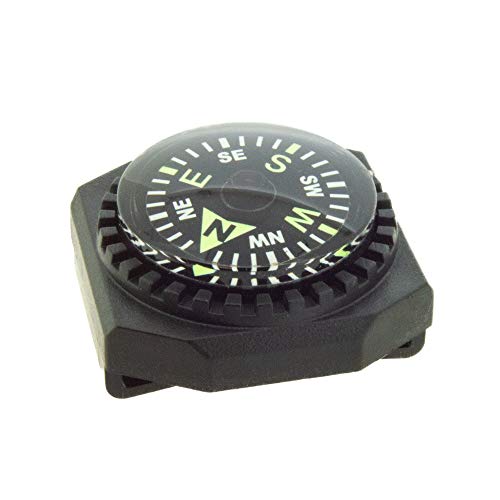
- Wearable on watch bands or paracord bracelets
- Luminous liquid-filled dial for low light
- Durable, compact ABS backup compass
Best For: Hands-free backup navigation on outdoor trips
Clip-On Trail Companion

- Attaches to packs or belts with a carabiner
- Liquid-filled for smooth directional readings
- Luminous markers and lightweight aluminum body
Best For: Quick-access navigation while hiking or camping
Reliable Trail Companion
Coghlan's Liquid-Filled Clip Compass

- Liquid-filled for reliable readings
- Clip attaches to packs, belts, or keychains
- Rotating bezel and lightweight construction
Best For: Hiking, camping, and basic orienteering
Classic Pocket Pick
Metal Camping Survival Compass

- Compact pocket design with 0.04 kg weight
- Metal case with mirror-finished surface
- Clear luminous dial and scale
Best For: Casual outdoor use and beginner navigation
Map-Reading Mini
Waterproof Orienteering Compass

- Waterproof and compact acrylic design
- Includes magnifying glass, lanyard, and orienting lines
- Features a 1:24000 map scale
Best For: Map reading, scouting, and backpacking
Best Trail Map Compass – Suunto A-10
The Suunto A-10 is a practical choice among compact compasses for hikers and orienteering users who want a straightforward baseplate design. Its liquid-filled capsule, high-grade steel needle, fixed declination, and inch/cm scales support basic map-and-compass navigation without batteries.
Best For: Recreational hiking, orienteering, trekking, trail running, and map-based navigation in the Northern Hemisphere.
Pros:
- Simple, fast-to-use baseplate design
- Liquid-filled capsule supports stable operation
- Includes inch/cm scales and fixed declination
- Lightweight, portable construction with lanyard mounting
Cons:
- Balanced specifically for Northern Hemisphere use
- Plastic construction may feel less rugged than metal alternatives
The A-10 focuses on dependable recreational navigation rather than extra features. It is a sensible compact compass for users who primarily read maps and want a lightweight, no-battery backup.
Best Keychain Compass – Brunton TAG-Along
The Brunton TAG-Along stands out among compact compasses for everyday carry and quick orientation. At 0.5 ounces, it can attach to a backpack, jacket, or keychain, while its weatherproof design and glow-in-the-dark face add usefulness for outdoor backup navigation.
Best For: Everyday carry, camping, hiking, travel, emergency kits, and quick cardinal-direction checks.
Pros:
- Very lightweight and easy to attach
- Phosphorescent face improves low-light readability
- Rugged and waterproof for outdoor conditions
- Bright lanyard helps keep it accessible
Cons:
- Designed for simple orientation rather than detailed map navigation
- Small format may be less convenient for extended route work
This is a convenient analog backup rather than a full-featured orienteering instrument. Choose it when portability, visibility, and quick access matter most.
Best Beginner Map Compass – Advanced Scout Compass
This scout-style model is one of the more feature-oriented compact compasses for beginners, combining a rotating 360-degree bezel, liquid-filled capsule, orienting lines, and a magnifying glass. Its 1:24000 scale and acrylic baseplate are intended for basic map reading and route planning.
Best For: Beginner hikers, campers, scouts, students, and users learning basic land navigation.
Pros:
- Rotating bezel with azimuth bearing
- Includes magnifying glass for map reading
- Provides a 1:24000 ruler scale
- Lightweight design includes a lanyard
Cons:
- 30-day warranty is shorter than some alternatives
- Acrylic construction may not suit demanding professional use
- Larger than the smallest keychain-style compasses
With more map-reading features than a basic direction finder, this compass can help new users practice route planning. It is best suited to casual outdoor activities and introductory navigation.
Best Ultralight Compass – Suunto Micro Compass
The Suunto Micro Compass is designed for users who want exceptionally compact navigation gear. It clips to a sleeve, watch strap, backpack strap, or map edge, and its liquid-filled jewel-bearing construction, luminous markings, and 10-degree rotating bezel provide directional guidance without taking up much space.
Best For: Ultralight hiking, trail running, skiing, backpacking, and underwater navigation in the Northern Hemisphere.
Pros:
- Extremely small and lightweight design
- Clip mounting keeps hands free
- Waterproof construction supports underwater use
- Luminous markings aid low-light operation
Cons:
- Balanced for Northern Hemisphere use
- Small format is less suited to detailed map work
- 10-degree bezel increments offer less fine adjustment than some larger compasses
The Micro Compass prioritizes portability and hands-free access over a full baseplate layout. It is a strong fit for carrying a directional backup on activities where space and weight are limited.
Wrist-Ready Backup – Slip-On Wrist Compass
For hikers, campers, and survival-kit builders who want compact compasses close at hand, the Sun Company Slip-On Wrist Compass provides a lightweight backup navigation option. Its ABS housing, cushion-mounted design, and luminous liquid-filled dial are built for convenient use on standard watch bands or paracord bracelets.
Best For: Outdoor users who want a wearable backup compass for hiking, camping, or low-light adventures.
Pros:
- Slides onto most standard watch bands and homemade paracord bracelets.
- Luminous liquid-filled compass supports low-light use.
- Durable ABS housing with a cushion-mounted compass.
- Very compact at approximately 1 by 0.6 inches.
Cons:
- Designed as a backup compass rather than a primary map-navigation instrument.
- Requires a compatible watch band or bracelet for wrist mounting.
This is a practical choice when accessibility matters more than a full-size compass layout. Wear it alongside your usual navigation gear for an immediately available directional reference.
Clip-On Trail Companion – Coghlan's Carabiner Compass
Among compact compasses for hiking and camping, Coghlan’s carabiner model stands out for easy gear attachment. The liquid-filled directional tool clips to a backpack or belt, while luminous markings and a lightweight aluminum body make it suited to quick checks on the trail.
Best For: Hikers, campers, and backpackers who want a portable compass that clips onto their gear.
Pros:
- Built-in carabiner provides convenient backpack or belt attachment.
- Liquid-filled design supports smooth directional readings.
- Luminous markers improve visibility in low-light conditions.
- Lightweight aluminum construction weighs about 0.6 ounces.
Cons:
- Compact format offers less viewing area than a larger navigation compass.
- Its clip-on design may be less suitable for users who prefer handheld mounting.
Choose this model if quick access and easy carry are priorities. It adds a useful navigation tool to a pack or belt without taking much space or weight.
Pocket Gift Compass – Mini Titanium/Brass/Copper Compass
For shoppers seeking compact compasses with a giftable design, this mini pocket compass combines portability with decorative appeal. It is about the size of a nickel, includes a necklace and carrying case, and offers IPX5 water resistance, glow-in-the-dark visibility, and a choice of titanium alloy, brass, or copper styling.
Best For: Hikers, scouts, students, and gift recipients who want a small wearable compass for everyday carry or outdoor kits.
Pros:
- Extremely portable at approximately 1.08 by 0.89 inches.
- Includes a necklace and carrying case for flexible storage or wear.
- IPX5 water resistance and glow-in-the-dark visibility support outdoor use.
- Durable, corrosion-resistant metal construction with an aesthetic finish.
Cons:
- Small size can make readings less convenient than with a larger compass.
- Accuracy may be affected by magnetic fields, metal objects, electronics, or uneven handling.
- Requires exposure to light before the glow-in-the-dark feature is useful.
This model is a strong fit when portability and presentation are as important as basic direction finding. Use it on a level surface and away from magnetic interference for the most dependable reading.
Reliable Trail Companion – Coghlan's Liquid-Filled Clip Compass
Coghlan's Compass – Trail, Lightweight Navigation Tool for Hiking, Camping, Survival & Orienteering
Check Price On AmazonFor hikers and campers seeking compact compasses, Coghlan’s liquid-filled model offers a lightweight design with practical attachment and direction-setting features. Its rotating bezel and durable plastic construction make it a useful option for basic trail navigation, orienteering, and outdoor preparedness.
Best For: Hiking, camping, orienteering, and minimalist outdoor kits.
Pros:
- Liquid-filled design supports reliable readings.
- Integrated clip attaches easily to backpacks, belts, or keychains.
- Rotating bezel with direction-setting arrow helps with course adjustments.
- Lightweight, durable plastic construction adds little bulk.
Cons:
- Plastic construction may feel less substantial than a metal compass.
- Designed for practical navigation rather than advanced specialized features.
Choose this compass if easy access and low carry weight matter most. The clip and rotating bezel make it especially convenient for casual navigation and everyday outdoor use.
Classic Pocket Pick – Metal Camping Survival Compass
This compact compass combines a pocket-friendly design with a durable metal case and a clear, luminous dial. It is suited to hikers, campers, families, and kids who want a portable navigation tool, provided it is used level and away from magnetic objects.
Best For: Casual hiking, camping, outdoor activities, and introductory navigation.
Pros:
- Compact and portable pocket-compass design.
- Metal case has a smooth, mirror-finished surface.
- Clear scale and luminous dial support easy reading.
- Light 0.04 kg construction is convenient to carry.
Cons:
- Must be held horizontally for correct operation.
- Magnetic objects can interfere with its function.
- Notes do not indicate additional map-reading features.
This is a straightforward choice when appearance, portability, and a metal case are priorities. Keep it level and separated from magnetic gear for the most dependable use.
Map-Reading Mini – Waterproof Orienteering Compass
Among compact compasses, this mini waterproof model stands out for map-reading support and easy portability. Its magnetic needle, directional arrow, orienting lines, magnifying glass, lanyard, and 1:24000 scale make it a versatile option for hiking, scouting, camping, and teaching navigation.
Best For: Map reading, backpacking, scouting, kids’ navigation practice, and outdoor exploration.
Pros:
- Waterproof acrylic construction is designed for outdoor use.
- Includes orienting lines, directional arrow, lanyard, and magnifying glass.
- 1:24000 ruler scale supports route mapping.
- Compact and portable for pockets or hiking backpacks.
Cons:
- Plastic construction may be less rugged than metal alternatives.
- Its map features may be more than needed for simple casual direction finding.
This model is the strongest fit for users who want more than a basic needle compass. The waterproof build and map-oriented features add usefulness for learning, route planning, and varied outdoor activities.
How We Picked These Compact Compasses
We focused on compasses that are small enough for daypacks, pockets, watch bands, keychains, or emergency kits while still offering useful directional guidance. The selection includes established outdoor brands such as SUUNTO, Brunton, Coghlan’s, and Sun Company, along with compact novelty and survival-oriented designs.
We considered intended use, compass format, readability, waterproofing, carrying options, and whether each design is suited to map work or primarily quick directional checks. A compact compass is most useful when its features match your navigation experience and the conditions in which you plan to use it.
Quick Comparison
| Best For | Look For | Recommended Format |
|---|---|---|
| Hiking and basic trail use | Clear markings and a stable needle | Baseplate compass |
| Map navigation | Long straight edges and degree markings | Orienteering compass |
| Emergency kits | Small size, durability, and simple operation | Liquid-filled pocket compass |
| Wearable access | Secure attachment and glanceable markings | Wrist or slip-on compass |
| Children and beginners | Simple controls and easy-to-read direction markers | Basic recreational compass |
Key Buying Factors for Compact Compasses
Size and Carrying Method
Smaller is not always better. A keychain or button compass is convenient for emergency reference, but a slightly larger baseplate is easier to read and more practical for following a map. Choose a wrist, carabiner, necklace, or pocket design if quick access matters more than detailed route planning.
Readability and Navigation Features
Look for high-contrast cardinal directions, visible degree markings, and a needle that settles quickly. For map navigation, a transparent baseplate, ruler edges, orienting lines, and a rotating bezel are more valuable than decorative styling or extra survival features.
Durability and Water Resistance
Outdoor compasses may face rain, mud, drops, and temperature changes. Liquid-filled housings can help stabilize the needle, while waterproof or water-resistant construction adds protection. Check the stated rating and construction rather than assuming every small compass is suitable for prolonged wet conditions.
Hemisphere Compatibility
Some compasses are balanced for a particular hemisphere. If you travel internationally, verify that the compass is designed for your region or is globally balanced. This matters most when you expect accurate needle movement in unfamiliar locations.
Intended User
Beginners generally benefit from a straightforward compass with minimal setup. Experienced hikers and orienteers may prefer a full baseplate with map scales and a rotating bezel. A decorative metal pocket compass can make a useful gift or backup, but it may not replace a dedicated navigation compass.
Who Should Buy Which Compact Compasses?
Choose the SUUNTO A-10 or a comparable baseplate model for dependable recreational hiking and basic map work. The Brunton TAG-Along is a practical choice when compact storage and quick access are priorities.
For children, beginners, or introductory outdoor activities, a simple orienteering-style compass with clear markings is easier to understand. A Sun Company Slip-On Wrist Compass suits users who want direction available without reaching into a pack, while a Coghlan’s carabiner compass works well for attaching to a bag or gear loop.
For emergency preparedness, consider a waterproof pocket or multifunction compass, but test it before relying on it. If detailed navigation is the goal, prioritize a readable baseplate and map features over the smallest possible size. Finally, metal pocket compasses and miniature keychain models are best treated as convenient backups, gifts, or orientation aids unless their accuracy and construction have been verified.

