A smart lock without Wi-Fi can deliver convenient keyless entry without requiring a constant internet connection. Keypads, fingerprint readers, and Bluetooth controls offer practical access while helping simplify installation and everyday use.
We compare 10 standout models across entry methods, security features, connectivity, durability, and value so you can choose the right lock for your home, rental, or office door.
Best 10 Smart Lock Without Wifi Picks for 2026
Best Simple Keypad Pick

- No app, Wi-Fi, or Bluetooth required
- Up to 20 codes plus two backup keys
- Auto-lock, passage mode, and backlit keypad
Best For: Homes and rentals wanting simple code-based entry
Best Fingerprint Upgrade

- Fingerprint, app, code, fob, and key access
- Flexible one-time and recurring code options
- Local AES128 encryption with activity logs
Best For: Multi-user properties needing biometric and app management
Best No-App Deadbolt

- No app, phone setup, or Wi-Fi needed
- Up to 20 entry codes with auto-lock
- BHMA Grade 3 residential durability
Best For: Exterior residential doors needing simple keypad entry
Best Interior Fingerprint Lock
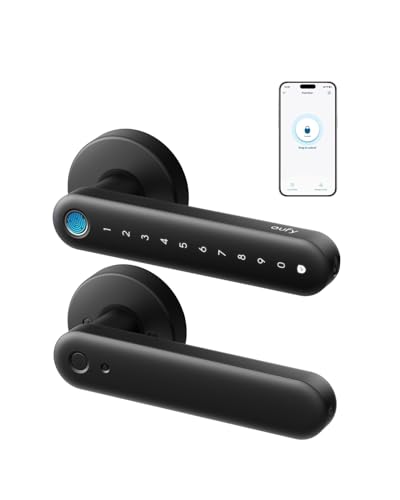
- 0.3-second fingerprint unlocking
- Built-in Wi-Fi with remote management
- Designed for interior doors, not front doors
Best For: Interior rooms needing fingerprint and voice-control access
Best Connected Keypad Pick
TEEHO TE011W WiFi Keypad Deadbolt

- Remote app control without an additional gateway
- Up to 100 customizable access codes
- IP55 design with auto-lock and activity alerts
Best For: Homes and rental properties needing flexible remote access
Best Fingerprint Entry

- Fingerprint unlocking takes less than one second
- Six entry methods, including Apple Watch and voice
- Eight-month battery estimate with no bridge required
Best For: Users wanting biometric access and eufy ecosystem integration
Best Secure Fingerprint Keypad
TEEHO TE012W Fingerprint Smart Door Lock
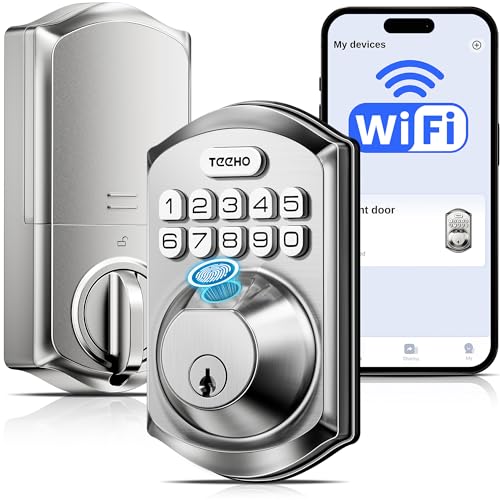
- Fingerprint entry for up to 20 users
- Anti-peeping PINs and incorrect-attempt lockout
- IP55, BHMA Grade 3, and two-year warranty
Best For: Shared homes, offices, and rentals needing managed access
Best Connected Option

- Bluetooth and keypad access
- Up to 200 customizable codes
- USB-C backup and IP54 rating
Best For: Flexible local access with optional remote WiFi control
Best WiFi-Free Pick

- Fingerprint entry in under 0.3 seconds
- Bluetooth access without built-in WiFi
- Up to 12 months of battery life
Best For: Fast biometric entry and local Bluetooth control
Best Feature-Rich Upgrade

- Fingerprint, passcode, and app entry
- Built-in 2.4GHz WiFi needs no hub
- Scheduled codes and access history
Best For: Remote management and broad connected access options
Best Simple Keypad Pick – NICE DIGI Keypad Door Lock
If you want a smart lock without wifi, this keypad model keeps entry straightforward: use a passcode or one of the backup keys, with no app or Bluetooth setup required. It also adds useful flexibility for homes, rentals, offices, and garages.
Best For: Households, rental properties, and offices needing multiple codes without connected features.
Pros:
- Supports up to 20 personalized 4–8 digit codes, including temporary one-time codes.
- Offers auto-lock settings from 5–99 seconds plus a passage mode.
- Backlit keypad, anti-peeping password entry, two backup keys, and low-battery alerts.
- Designed for DIY installation on most standard US and Canadian wooden doors.
Cons:
- Four AA batteries are required but are not included.
- No app, Wi-Fi, or Bluetooth means access cannot be managed remotely.
This is a practical choice if you value simple, local keypad access over remote monitoring. Its reversible handle and passage mode make it especially adaptable for busy homes and rental use.
Best Fingerprint Upgrade – Veise VE017 Smart Door Lock
Although it is more connected than a typical smart lock without wifi, the Veise VE017 stands out for shoppers who want fingerprint access, app management, and detailed user controls in one system. Its local encryption and multiple unlock methods add flexibility.
Best For: Multi-tenant properties and households that need fingerprints, remotely managed codes, and access logs.
Pros:
- Provides fingerprint, app, code, fob card, authorized access, and mechanical-key entry options.
- Supports permanent, recurring, duration, and one-time codes that can be managed in the app.
- Stores access data locally with AES128 encryption and provides activity logs and alerts.
- Includes anti-peeping PIN protection, intrusion defense, silent mode, and away mode.
Cons:
- Requires app connectivity for its remote management features, so it is not a no-connectivity lock.
- Remote voice-assistant compatibility requires the G1 Gateway.
Choose this model when biometric access and detailed permissions matter more than a purely offline design. It offers the broadest management feature set here, but buyers seeking a strictly smart lock without wifi should consider a keypad-only alternative.
Best No-App Deadbolt – Yale Code Keypad Deadbolt
The Yale Code is a strong fit for anyone searching for a smart lock without wifi that feels familiar to install and use. It provides keyless entry through a backlit keypad, while avoiding app setup, phone pairing, and connected-service requirements.
Best For: Residential exterior doors where dependable keypad access and straightforward operation are the priorities.
Pros:
- Works without an app, phone setup, or Wi-Fi.
- Creates up to 20 unique entry codes for family, guests, or service providers.
- Includes auto-lock, a backlit keypad, backup key, and low-battery alerts.
- BHMA Grade 3 certified and rated for temperatures from -22°F to 140°F.
Cons:
- As a deadbolt, it does not include a door handle or lever.
- No remote access, activity logs, or app-based code management.
For shoppers who want a recognized brand and uncomplicated keyless deadbolt, the Yale Code keeps the feature set focused. It is less versatile than connected locks, but that simplicity can be an advantage for everyday residential use.
Best Interior Fingerprint Lock – eufy FamiLock C32
The eufy FamiLock C32 is not a smart lock without wifi—it has built-in 2.4 GHz Wi-Fi—but it is worth considering if fingerprint convenience and remote management appeal to you. Its design is aimed at interior doors rather than primary front-door security.
Best For: Bedrooms, offices, storage areas, garages, and other standard interior doors.
Pros:
- Fingerprint unlocking takes about 0.3 seconds and supports self-learning recognition.
- Built-in Wi-Fi enables remote authorization and lock management.
- Works with Alexa and Google Assistant for voice control.
- Offers auto-lock, four AA batteries, and USB-C emergency power backup.
Cons:
- It uses built-in Wi-Fi, so it does not meet a strict no-Wi-Fi requirement.
- The manufacturer notes that it is not recommended for front doors.
- Battery life is listed at over five months, shorter than some keypad-only options.
This lock makes sense when fast biometric entry and smart-home integration outweigh the desire for an offline setup. For a true smart lock without wifi, look instead at the keypad models in this roundup.
Best Connected Keypad Pick – TEEHO TE011W WiFi Keypad Deadbolt
If you want a smart lock without wifi limitations, the TEEHO TE011W adds direct 2.4GHz Wi-Fi connectivity for remote control without a separate gateway. Its keypad, app, voice, and key-entry options make it practical for households, guests, and rental access.
Best For: Homeowners and rental-property managers who need remote access, flexible passcodes, and activity notifications.
Pros:
- Supports app access, up to 100 passcodes, voice control, and two backup keys.
- Offers one-time, recurring, temporary, and permanent codes through the app.
- Includes adjustable 10–99-second auto-lock, activity history, and real-time alerts.
- Uses eight AA batteries and has IP55 weather resistance.
Cons:
- Requires eight AA batteries, which are not included.
- Wi-Fi connectivity is limited to 2.4GHz networks.
The TE011W is a strong choice when remote management and code sharing matter more than fingerprint entry. Its broad access options and local data protection make it especially useful for busy homes and rentals.
Best Fingerprint Entry – eufy Security Smart Lock C220
For shoppers comparing a smart lock without wifi dependency, the eufy Security Smart Lock C220 combines built-in Wi-Fi remote control with fast fingerprint entry. It also supports app, keypad, physical-key, smartwatch, and voice access.
Best For: Users who want biometric entry, remote app control, and integration with other eufy security products.
Pros:
- Provides six unlocking methods, including fingerprint access in under one second.
- Runs on eight AA batteries for approximately eight months, depending on use.
- Installs in about 15 minutes without drilling and fits many standard deadbolts.
- Offers BHMA Grade 3 certification, unusual-attempt alarms, and IP53 water resistance.
Cons:
- Fingerprint access may be unnecessary for buyers who prefer keypad-only locks.
- Remote control requires a Wi-Fi connection and the eufy Security app.
The C220 stands out for fast biometric access and broad compatibility with eufy devices. Its built-in Wi-Fi avoids a bridge, while the physical key and keypad provide useful alternatives.
Best Secure Fingerprint Keypad – TEEHO TE012W Fingerprint Smart Door Lock
The TEEHO TE012W is a practical option for anyone seeking a smart lock without wifi setup complexity, while still wanting remote app access. It connects directly to 2.4GHz Wi-Fi and adds fingerprint, passcode, key, and voice-entry choices.
Best For: Families, offices, apartments, and rental properties that need multiple entry methods and controlled code sharing.
Pros:
- Supports fingerprints for up to 20 users and up to 100 passcodes.
- Includes anti-peeping passwords and a three-minute lockout after 10 incorrect PIN attempts.
- Offers adjustable auto-lock, one-touch locking, silent mode, and away mode.
- Has BHMA Grade 3 certification, IP55 weather resistance, and a two-year warranty.
Cons:
- Works with 2.4GHz Wi-Fi only.
- Requires eight AA batteries and a screwdriver for installation.
With biometric access plus detailed keypad protections, the TE012W is more security-focused than a basic smart deadbolt. Its app-based user management and broad fit range also suit shared homes and rental doors.
Best Connected Option – Tapo DL100 Smart Deadbolt
The Tapo DL100 is a practical choice if you want a smart lock without WiFi dependence for everyday nearby access, while still having the option of remote control when WiFi is enabled. Bluetooth, keypad, physical keys, and app features give you several ways to get inside.
Best For: Households that want flexible keypad and Bluetooth access with optional remote WiFi control.
Pros:
- Supports keypad codes, Bluetooth, physical keys, app control, and voice commands.
- Offers up to 200 customizable codes, activity timestamps, alerts, and customizable auto-lock.
- Includes USB-C emergency power, four AA batteries, IP54 weather resistance, and BHMA Grade 3 certification.
Cons:
- Remote control and some smart-home features require WiFi, so it is not a WiFi-free model for all functions.
- Voice unlocking requires PIN verification and a compatible smart-home setup.
The DL100 stands out for its balance of local Bluetooth convenience and connected features. Choose it if you want a keypad-first lock that can also provide remote access when needed.
Best WiFi-Free Pick – DESLOC B200 Fingerprint Lock
The DESLOC B200 is a strong fit for shoppers seeking a smart lock without WiFi. Its core access methods work over Bluetooth or directly at the lock, including fingerprint recognition, PIN codes, key fobs, eKeys, and physical keys.
Best For: Homes that prioritize fast biometric entry and local Bluetooth control instead of built-in WiFi.
Pros:
- Provides fingerprint, PIN, key fob, eKey, physical-key, and Bluetooth app access.
- Fingerprint recognition is designed to unlock in under 0.3 seconds and supports up to 50 fingerprints.
- Offers up to 12 months of battery life, USB-C emergency power, IP54 protection, and BHMA Grade 3 compliance.
Cons:
- Remote access and voice control require the separately sold G2 Gateway.
- Four AA batteries are required but are not included.
For a WiFi-free smart lock setup, the B200 keeps everyday access simple and local. Its fingerprint sensor is the main attraction, while the optional gateway adds connected features if your needs change.
Best Feature-Rich Upgrade – Philips WiFi Smart Deadbolt
The Philips DDL242X-1HW is designed for shoppers who want extensive access options, though it is less suited to a strict smart lock without WiFi setup. Built-in 2.4GHz WiFi enables remote control without a hub, while fingerprint, passcode, app, voice, and physical-key entry cover daily use.
Best For: Connected households that want remote access, fingerprint entry, scheduled codes, and voice control in one lock.
Pros:
- Supports app, passcode, fingerprint, physical-key, Alexa, and Google Assistant access.
- Creates up to 100 custom passcodes plus one-time or scheduled guest codes.
- Includes alerts, access history, adjustable auto-lock, Away Mode, and no-hub remote WiFi control.
Cons:
- Requires a 2.4GHz WiFi network for remote functionality and is not the best fit for a WiFi-free setup.
- Batteries are not included, and the lock requires AA alkaline batteries.
- It does not include a door sensor.
The Philips lock offers the broadest connected feature set in this group, but its built-in WiFi is central to the experience. Consider it when remote management matters more than avoiding WiFi.
How We Picked the Best Smart Lock Without Wifi
We focused on locks that support local, offline-friendly entry methods such as PIN codes, fingerprints, physical keys, and Bluetooth. We also considered whether each model is a deadbolt or complete handle set, its compatibility with common door preparations, battery access, weather resistance, and the clarity of its installation and user-management features.
Some products in this roundup include Wi-Fi or app connectivity. These options can still be useful when you want local keypad or fingerprint access as a primary method, but buyers should review the app and network requirements before purchase.
Quick Comparison
| Lock type | Best for | Entry methods to look for |
|---|---|---|
| Keypad deadbolt | Simple code-based access | PIN, key, optional app |
| Fingerprint lock | Fast family access | Fingerprint, PIN, key |
| Handle set | Replacing the full exterior handle | Fingerprint, PIN, key |
| Connected lock | Remote control and notifications | App, PIN, fingerprint, key |
Key Buying Factors for a Smart Lock Without Wi-Fi
Entry Method and User Capacity
Choose a keypad if you want dependable code access without carrying keys. Fingerprint readers are faster for frequent users, but performance depends on clean, properly registered fingerprints. Check how many codes or fingerprints the lock stores if several household members, guests, or employees need access.
Door Compatibility and Installation
Confirm the required backset, door thickness, bore-hole dimensions, handing, and whether the product replaces a deadbolt or a complete handle. A handle-style lock may not fit a door prepared only for a standard deadbolt. Measure before ordering, and verify that the latch and strike align correctly.
Power, Backup Access, and Security
Battery life varies with usage and features, so choose a model with clear low-battery warnings. An exterior emergency power connection and a physical key override are valuable safeguards. Look for automatic locking, anti-peep keypad entry, tamper alerts, and a sturdy deadbolt or latch.
Connectivity and Privacy
If you specifically want a smart lock without Wi-Fi, prioritize standalone operation and Bluetooth or no-app access. Wi-Fi models can add remote unlocking and activity notifications, but they may require a hub, account, or cloud connection. Review permissions and avoid enabling remote features you do not need.
Who Should Buy Which Smart Lock Without Wifi?
Choose a basic keypad deadbolt for straightforward, low-maintenance keyless entry. Pick a fingerprint model for busy households that want quick access without remembering codes. A handle set is the better choice when replacing the entire exterior lockset. Choose a connected Yale, eufy, Tapo, TEEHO, Philips, or similar model when remote management and notifications matter more than keeping the system completely offline. For rentals, offices, or guest access, prioritize easy code creation, temporary credentials, and a reliable mechanical backup.

