Power outages and severe weather can disrupt phone service, lighting, and access to reliable information. The best emergency radios with hand crank combine weather alerts with multiple backup power options, so you are not dependent on a wall outlet.
We compared this selection for charging flexibility, radio coverage, battery capacity, lighting, alert features, and ease of use. Whether you want a compact storm kit radio or a higher-capacity emergency power station, the right choice depends on how you plan to use it.
Best 10 Emergency Radios with Hand Crank Picks for 2026
Best All-Around Choice
FosPower NOAA Emergency Radio A1

- NOAA, AM, and FM reception
- 2,000mAh phone-charging power bank
- Solar, crank, USB-C, and AAA power options
Best For: Home emergency kits and versatile outage preparedness
Best Simple Hand-Crank Option
Ready America 70801 Power Station

- Radio, flashlight, siren, and phone charger
- Hand-powered operation without batteries
- Rated for short-term light and radio use after cranking
Best For: Basic emergency kits and simple outage readiness
Best High-Capacity Pick
Roxicosly Emergency Weather Radio
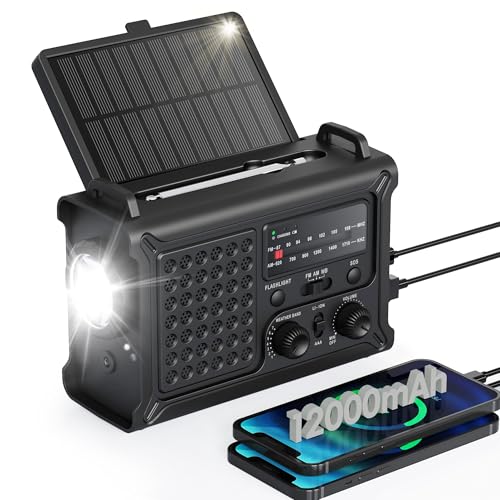
- Claimed 12,000mAh battery
- Seven NOAA bands with automatic alerts
- IPX6 waterproofing and dual emergency lights
Best For: Extended outages, storms, and outdoor preparedness
Best Compact Design

- Lightweight, compact emergency format
- Hand-crank, solar, and rechargeable power
- AM/FM radio, lights, SOS alarm, and USB charging
Best For: Small kits, camping, and portable backup use
Best Multi-Powered Pick
Philips TAR3500 Emergency Radio

- Four charging methods, including hand crank and solar
- 5200 mAh battery with up to 60 hours of radio playtime
- IP55 design with SOS alert, lights, and phone charging
Best For: Home kits, outages, camping, and extended emergency readiness
Best with Extra Features
PandaXun Army Green Emergency Radio

- AM/FM and weather-band reception
- Solar, hand-crank, and USB-C charging
- LED light, SOS alarm, and 2,000mAh battery
Best For: Families, campers, and hikers needing versatile emergency backup
Best All-Around Choice – FosPower NOAA Emergency Radio A1
For shoppers comparing emergency radios with hand crank charging, the FosPower A1 offers a balanced combination of NOAA, AM, and FM reception, backup charging, and emergency lighting. Its 2,000mAh power bank can help recharge a small phone or tablet, while solar, hand-crank, and AAA battery options provide flexibility during outages.
Best For: Home emergency kits and users who want versatile charging, weather updates, and multiple lights in one compact radio.
Pros:
- Receives NOAA, AM, and FM broadcasts.
- Offers solar, hand-crank, USB-C, and AAA battery power options.
- Includes a 2,000mAh power bank, 1W flashlight, and four-LED reading light.
- Backed by a limited lifetime warranty.
Cons:
- The 2,000mAh power bank is intended for smaller devices rather than extended charging.
- Requires four AAA batteries when rechargeable sources cannot be used.
The FosPower is a practical middle-ground option for preparedness: it combines broad radio coverage and useful lighting with several ways to restore power. Its compact, water-resistant design also suits storage in an emergency kit or use outdoors.
Best Simple Hand-Crank Option – Ready America 70801 Power Station
The Ready America 70801 is a straightforward choice among emergency radios with hand crank charging. Its four core functions—AM/FM radio, flashlight, siren, and cell-phone charger—focus on essential outage needs, and the hand crank works without disposable batteries.
Best For: Buyers who want a basic, hand-powered emergency station for short-term lighting, news, alerts, and phone charging.
Pros:
- Combines radio, flashlight, siren, and cell-phone charging.
- Hand-crank operation requires no batteries.
- One minute of cranking is rated for up to 30 minutes of light or 15 minutes of radio.
- Includes iPhone 4s-and-earlier, USB, and Mini-USB plugs.
Cons:
- Supports AM/FM rather than NOAA weather-band reception.
- Not water resistant.
- Its phone connectors may not suit newer devices without the appropriate cable.
This model favors simplicity over expanded features. It makes sense for a basic emergency drawer or kit, especially when battery-free operation and an integrated siren matter more than weather alerts or a large rechargeable battery.
Best High-Capacity Pick – Roxicosly Emergency Weather Radio
For shoppers seeking emergency radios with hand crank charging and substantial backup power, this Roxicosly model pairs a claimed real 12,000mAh battery with a large monocrystalline solar panel. It also provides AM/FM and seven NOAA bands, dual emergency lights, automatic weather alerts, and IPX6 waterproofing.
Best For: Extended outages, storm preparation, camping, and outdoor users who prioritize battery capacity and weather-alert coverage.
Pros:
- Includes a stated 12,000mAh emergency battery for USB-device charging.
- Uses a large 8,500mm² solar panel and reinforced hand-crank generator.
- Offers AM/FM, seven NOAA bands, automatic alerts, and a loud SOS alarm.
- Features a 5W adjustable flashlight, 12-LED reading lamp, and IPX6 waterproofing.
Cons:
- The 824-gram weight is heavier than many compact emergency radios.
- Solar and hand-crank charging performance depends on available light and effort.
- The large battery may be more capability than needed for a small, minimalist kit.
This is the feature-rich choice for users who want more than basic emergency communication. Its larger battery, weather alerts, lighting, and water resistance make it well suited to demanding preparedness and outdoor scenarios.
Best Compact Design – Sentinelle Pro Crank Radio
The Sentinelle Pro is a compact option for shoppers comparing emergency radios with hand crank, solar, and rechargeable power. It receives AM/FM broadcasts, includes a 1W LED flashlight and reading lamp, and can provide emergency USB charging for compatible devices.
Best For: Small emergency kits, camping, and users who value a lightweight radio with basic lighting and multiple charging methods.
Pros:
- Compact dimensions of approximately 5 x 2.36 x 1.77 inches and weight of about 0.64 pounds.
- Provides hand-crank, solar, and built-in rechargeable power options.
- Includes AM/FM reception, a retractable antenna, flashlight, and reading lamp.
- Offers USB phone charging and an SOS alarm.
Cons:
- Its radio coverage is listed as AM/FM rather than NOAA weather bands.
- The listed 600mAh/2,000mWh capacity is modest for phone charging.
- Charging performance depends on the device and conditions.
The Sentinelle Pro is best viewed as a lightweight backup rather than a high-capacity power station. Its small footprint and three power options make it convenient for a go-bag, desk drawer, or occasional outdoor use.
Best Multi-Powered Pick – Philips TAR3500 Emergency Radio
Philips TAR3500 Multi‑Powered Emergency Radio with AM/FM, SOS Siren & Power Bank
Check Price On AmazonFor shoppers comparing emergency radios with hand crank charging, the Philips TAR3500 stands out for its broad mix of power options and practical emergency features. It supports USB-C, solar, hand-crank, and AAA-battery operation, plus AM/FM digital tuning, lighting, and phone charging.
Best For: Home emergency kits, outages, camping, and users who want long radio runtime with flexible recharging.
Pros:
- Offers four power options: USB-C, solar, hand crank, and AAA batteries.
- 5200 mAh battery provides up to 60 hours of radio playtime and can charge devices through USB-A.
- Combines AM/FM digital tuning with an SOS siren, flashing light, ultrasonic whistle, torch, and reading light.
- IP55 dust- and water-resistant housing supports outdoor and emergency use.
Cons:
- Heavier and larger than the other listed compact radios at about 0.95 kg.
- Uses four AAA batteries, which must be purchased separately.
The TAR3500 is the most feature-rich option in this group, especially if dependable battery capacity and multiple backup charging methods matter more than minimizing size and weight.
Best Weather-Alert Value – Emergency Hand Crank Radio
This compact option is one of the practical emergency radios with hand crank charging for weather-focused preparedness. It receives NOAA and AM/FM broadcasts, includes a 2000 mAh battery with USB charging support, and adds solar and hand-crank power for outages.
Best For: Shoppers seeking a lightweight radio for storm alerts, blackouts, and basic emergency lighting.
Pros:
- Designed to receive NOAA and AM/FM weather alerts for events such as hurricanes and tornadoes.
- Provides solar, hand-crank, and USB charging options.
- Built-in 2000 mAh battery can charge mobile devices through USB.
- Four-mode flashlight adds flexible illumination during blackouts.
Cons:
- Its listed radio-band detail is 3-band, with AM tuning specified in the product information.
- Smaller 2000 mAh capacity offers less reserve than the Philips model.
- Brand and model information are generic in the supplied listing.
At about 11.04 ounces, this radio is easy to store or carry, making it a sensible choice when portability and weather information are the priorities.
Best for Comfort – Sentinelle Pro Emergency Radio
The Sentinelle Pro is a small, lightweight choice among emergency radios with hand crank charging. It combines AM/FM reception, solar and hand-crank charging, USB phone charging, an SOS alarm, and a 1W LED flashlight in a compact body.
Best For: Travelers, campers, and emergency-kit users who need a small radio with basic lighting and backup charging.
Pros:
- Compact dimensions of approximately 5 x 2.36 x 1.77 inches and weight of about 0.64 lb.
- Supports hand-crank, solar, and built-in rechargeable-battery power.
- Includes AM/FM reception, a retractable antenna, USB phone charging, and an SOS alarm.
- Bright 1W LED flashlight helps illuminate dark spaces and outdoor areas.
Cons:
- Battery capacity is listed inconsistently as 600mAh/2000mAh in the supplied information.
- Does not list USB-C or AAA-battery operation as power options.
- Warranty information is listed as unavailable.
This is the easiest model here to pack and store, though its smaller size and unclear battery-capacity listing make it better suited to basic backup use than extended radio operation.
Best with Extra Features – PandaXun Army Green Emergency Radio
For shoppers comparing emergency radios with hand crank, this PandaXun model offers several ways to stay informed and prepared during blackouts, storms, and outdoor trips. It combines AM/FM and weather-band reception with solar, hand-crank, and USB-C charging.
Best For: Families, campers, and hikers who want a compact radio with backup power, lighting, and an SOS alarm.
Pros:
- Supports solar, hand-crank, and USB-C charging with a 2,000mAh battery.
- Receives AM, FM, and weather broadcasts.
- Includes a bright three-LED light, SOS alarm, and phone power-bank function.
- Compact ABS casing is rated IPX3 for light rain.
Cons:
- IPX3 protection is intended for light rain, not heavy water exposure.
- Uses mono audio through an 8-ohm, 2-watt speaker.
Its combination of communication, illumination, and charging features makes it a versatile emergency kit choice, especially when portability matters.
Best for Weather Alerts – Portable NOAA Hand Crank Radio
This portable emergency radio with hand crank is designed around weather awareness, with NOAA and AM/FM reception for alerts related to severe events such as tornadoes, hurricanes, and heavy snow. Its multiple charging options help keep the radio available during outages.
Best For: Households prioritizing NOAA weather updates, emergency lighting, and mobile-device backup power.
Pros:
- Receives NOAA and AM/FM weather information.
- Offers solar, hand-crank, and USB charging options.
- Includes a 2,000mAh battery and phone-charging power-bank function.
- Four-mode flashlight adds flexible blackout illumination.
Cons:
- The listing specifies a three-band radio but does not detail the individual band names beyond AM/FM and NOAA.
- The brand is listed as Generic.
Choose this model if receiving severe-weather information is your main priority and you also want a flashlight and rechargeable backup battery in one small unit.
Best Compact Orange Option – PandaXun Orange Emergency Radio
Among emergency radios with hand crank, this orange PandaXun version stands out for its highly visible color and compact size. It provides AM/FM and weather-band broadcasts, three charging methods, a flashlight, and an SOS alarm for home or outdoor emergencies.
Best For: Campers, hikers, and emergency-kit owners who want a compact, easy-to-spot radio in orange.
Pros:
- Compact 13.5 x 6.4 x 3.9 cm design fits easily in a pack.
- Uses solar, hand-crank, or USB-C charging with a 2,000mAh battery.
- Provides AM/FM and weather-band reception.
- Features a three-LED light and acoustic SOS alarm.
Cons:
- IPX3 protection is limited to light rain.
- Its speaker provides mono audio.
The orange housing can be useful when locating gear quickly, while the compact build and emergency functions make it practical for portable preparedness kits.
How We Picked the Best Emergency Radios with Hand Crank
We focused on practical features that matter during outages, storms, and evacuation situations. The products in this roundup were evaluated for NOAA weather-band access, AM/FM reception, hand-crank and solar charging, built-in battery capacity, USB output, flashlight performance, and emergency alerts. We also considered portability, controls, construction, and whether the feature set suits occasional home preparedness or more frequent outdoor use.
Because specifications can vary by seller or model revision, verify the current listing for battery capacity, charging ports, included accessories, and radio-band support before buying.
Quick Comparison
| What You Need | Look For | Best Fit |
|---|---|---|
| Basic emergency communication | AM/FM, NOAA, crank charging, flashlight | Compact multifunction radio |
| Longer device backup | Larger battery and USB power output | High-capacity emergency power station |
| Several charging options | Hand crank, solar panel, USB, and battery backup | Multi-powered weather radio |
| Nighttime emergencies | Bright flashlight, reading lamp, or SOS alarm | Radio with lighting and alert functions |
Key Buying Factors for Emergency Radios with Hand Crank
Power and Charging
A hand crank is a valuable last-resort power source, but it is not usually the fastest way to recharge a large battery. Solar charging is useful during extended outages, while USB charging is more practical before an emergency. Check whether the radio can charge a phone and whether its battery is large enough to provide meaningful backup power.
Weather Alerts and Reception
NOAA weather-band support is important if you live in an area affected by hurricanes, tornadoes, floods, or winter storms. A clearly tuned AM/FM radio can also provide local updates when internet and cellular service are unavailable. For the best results, use the radio where it can receive a strong signal and keep batteries maintained.
Lighting, Alerts, and Durability
Look for a useful flashlight, reading lamp, or SOS siren rather than treating every extra feature as equally important. Sealed or water-resistant construction can help in wet conditions, but confirm the exact rating. Simple controls, a visible tuning display, and a comfortable crank are especially valuable when using the radio in darkness or under stress.
Who Should Buy Which Emergency Radios with Hand Crank?
Choose a compact crank radio if you want an affordable addition to a household emergency kit, car, or backpack. Select a higher-capacity model if keeping a phone powered is a priority or if your area experiences longer outages. A solar-and-crank model offers the most flexibility for off-grid use, while a radio with a strong lamp and SOS alarm is better for nighttime emergencies or family preparedness.
Whichever model you choose, test it before storing it, charge its battery periodically, and keep it with spare cables, a printed contact list, and other emergency supplies.

