The best emergency radios help you stay informed when power, internet, or cellular service is unavailable. This roundup compares 10 practical options with NOAA alerts, hand-crank and solar charging, battery backup, flashlights, and other disaster-ready features.
Whether you need a compact radio for an emergency kit or a programmable home weather-alert receiver, these picks cover different budgets and preparedness needs.
Best 10 Emergency Radios Picks for 2026
Trusted All-Purpose Pick

- AM/FM with NOAA Weather Scan and Alert
- Solar power plus six included AA batteries
- SOS flashlight and ultrasonic dog whistle
Best For: General emergency kits and outdoor preparedness
Easy-Tuning Value
BAIJIALI Portable AM/FM/SW Radio

- Receives AM, FM, and shortwave signals
- 5W speaker with large, simple controls
- Rechargeable battery and USB power options
Best For: Home listening, travel, and simple outage preparation
Best Power-Backup Features
FosPower A1 NOAA Emergency Radio

- 7400mWh power bank for small devices
- Solar, hand-crank, and AAA-battery power
- NOAA weather access plus flashlight and reading light
Best For: Storm kits, outages, camping, and device charging
Best Connected Upgrade
Midland ER310PRO Weather Radio
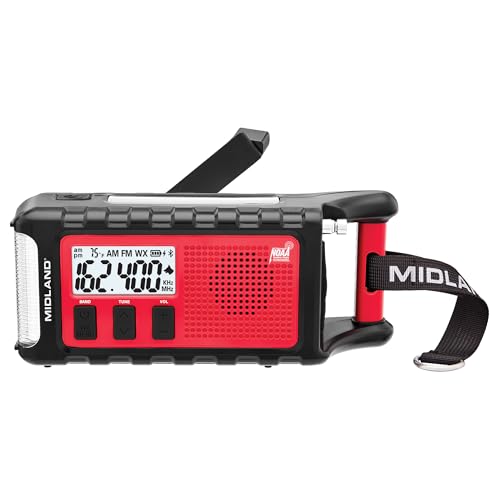
- 10,000mAh power bank for external devices
- Bluetooth streaming plus AM/FM/weather reception
- Solar and hand-crank charging with 130-lumen flashlight
Best For: Preparedness kits needing Bluetooth and robust device charging
Alert-Focused Pick
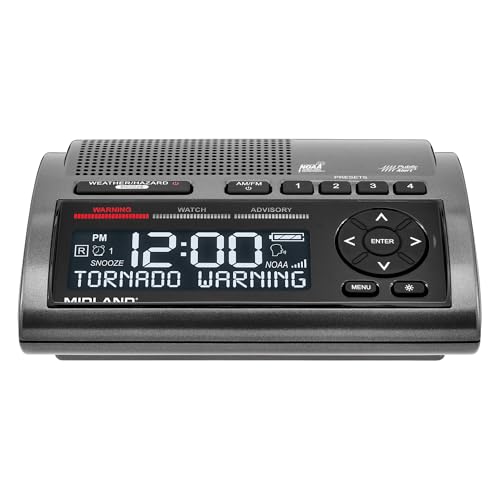
- Scans 10 NOAA weather channels
- Programs up to 25 counties
- Provides 80 alerts with flexible notifications
Best For: Home emergency monitoring and local warning alerts
Portable Power Pick
Midland ER40 Crank Weather Radio

- 2600 mAh rechargeable battery
- Hand-crank and solar charging
- NOAA alerts, FM radio, and flashlight
Best For: Portable emergency kits and power outages
Localized Alert Leader
RunningSnail S.A.M.E. NOAA Radio
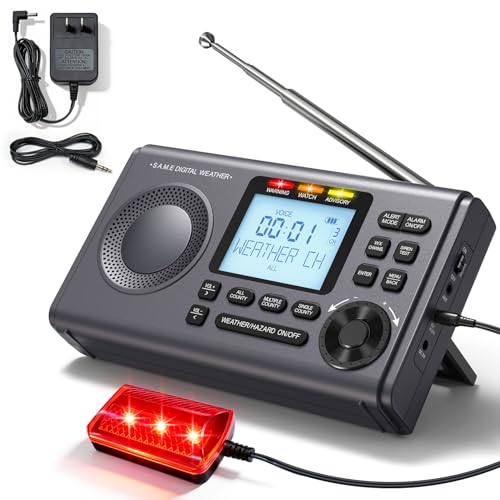
- S.A.M.E. support for up to 23 counties
- 80+ customizable alert types
- AC and AA battery backup
Best For: Home use in storm-prone areas
Everyday Desk Choice

- S.A.M.E. localized county alerts
- 80+ alerts with three notification modes
- FM radio, alarm, and dual power
Best For: Bedside, kitchen, and family emergency readiness
Trusted All-Purpose Pick – Midland ER310 Emergency Radio
The Midland ER310 is a practical choice among emergency radios for weather updates, outages, and outdoor preparedness. It combines AM/FM reception with NOAA Weather Scan and Alert, multiple power sources, a flashlight, and an ultrasonic dog whistle.
Best For: General emergency kits, outdoor activities, and shoppers who want several backup power options.
Pros:
- Supports multiple power sources, including solar power and six included AA batteries.
- NOAA Weather Scan and Alert helps provide severe-weather updates.
- Includes an SOS emergency flashlight and ultrasonic dog whistle.
Cons:
- Not water resistant.
- Does not list Bluetooth or a built-in power bank.
The ER310 focuses on core emergency functions rather than entertainment extras. Its combination of weather alerts, lighting, and backup power makes it a sensible preparedness staple.
Easy-Tuning Value – BAIJIALI Portable AM/FM/SW Radio
This BAIJIALI portable radio is a straightforward option for shoppers seeking emergency radios with broad everyday listening coverage. It receives AM, FM, and shortwave signals, uses a large tuner and simple controls, and can run from its rechargeable battery or USB power.
Best For: Home use, travel, and users who prioritize simple controls and a clear speaker.
Pros:
- Supports AM, FM, and shortwave bands across four listed bands.
- 5W speaker is designed for clear music, talk, and sports audio.
- Offers rechargeable-battery and DC 5V USB charging options.
- Large tuner and straightforward buttons can suit seniors and first-time users.
Cons:
- Not water resistant.
- Does not include NOAA weather-band reception or a flashlight.
With its broad tuning range and uncomplicated interface, this model is better suited to general radio listening and basic outage preparation than specialized severe-weather readiness.
Best Power-Backup Features – FosPower A1 NOAA Emergency Radio
The FosPower A1 stands out among emergency radios for combining weather-band reception, several charging methods, and device charging in a compact package. Its power bank, hand crank, solar panel, AAA battery option, lights, and SOS alarm make it well equipped for outages and outdoor emergencies.
Best For: Power outages, storm kits, camping, and anyone who wants emergency device charging.
Pros:
- 7400mWh (2000mAh) power bank can provide emergency power to a small tablet or phone.
- Uses solar, hand crank, and four AAA batteries for flexible power.
- Receives AM/FM/Weather Band broadcasts, including NOAA emergency information.
- Includes a 1W flashlight, four-LED reading light, and SOS alarm.
Cons:
- Speaker output is listed at 2 watts.
- Charging a larger device may require careful power management.
The A1 offers one of the most complete feature sets here for maintaining light, radio access, and limited device power when normal electricity is unavailable. Its water-resistant design also adds practical outdoor versatility.
Best Connected Upgrade – Midland ER310PRO Weather Radio
The Midland ER310PRO adds everyday connectivity to the core features expected from emergency radios. Along with AM/FM/weather reception and NOAA scanning, it provides Bluetooth streaming, a 10,000mAh power bank, solar and hand-crank charging, and a high-output emergency flashlight.
Best For: Preparedness shoppers who want Bluetooth audio and substantial backup charging capacity.
Pros:
- 10,000mAh power bank can charge phones and tablets through the included USB cable.
- Bluetooth supports music streaming from compatible devices.
- Solar and hand-crank charging provide alternatives during outages.
- NOAA scan, 130-lumen CREE flashlight, SOS beacon, and rescue dog siren add emergency utility.
Cons:
- Its listed tuner details are less specific than models that explicitly list multiple AM/FM frequency bands.
- The notes do not identify a water-resistance rating.
The ER310PRO is the most feature-rich choice for users who want an emergency radio that also works as a portable Bluetooth speaker and power bank. It is especially compelling when device charging is a priority.
Compact Crank Choice – Portable NOAA Radio with Torch
This compact emergency radio combines AM/FM and NOAA weather reception with several charging options. Its hand crank, solar panel, and Type-C input make it useful for a car kit, camping bag, or home emergency kit, while the built-in torch adds basic lighting during outages.
Best For: Buyers seeking a small, rechargeable emergency radio with a light and SOS alarm.
Pros:
- Charges through hand crank, solar power, or Type-C cable.
- Receives AM, FM, and NOAA weather broadcasts.
- Includes a 3-LED torch and SOS alarm.
- Compact IPX3 splash-resistant design.
Cons:
- Solar charging is slow and depends on sunlight.
- IPX3 protection covers light spray, not submersion.
- Mono speaker and compact size may limit sound output.
The Ywalxskk is a straightforward, space-saving option for basic alerts, backup lighting, and multiple charging methods. It is best suited to light-duty preparedness rather than demanding weatherproof use.
Alert-Focused Pick – Midland WR400 Weather Radio
The Midland WR400 is a home-oriented emergency radio built around detailed NOAA alerting. It can scan available weather channels, connect to county-specific S.A.M.E. warnings, and provide audible, voice, or visual notifications, with battery backup for power outages.
Best For: Home users who want configurable local weather and emergency alerts.
Pros:
- Automatically scans 10 NOAA weather channels.
- S.A.M.E. programming supports up to 25 counties.
- Offers 80 emergency alert types with siren, voice, or LED notification options.
- Includes AM/FM radio, clock, alarm, snooze, and USB output.
Cons:
- Requires four AA batteries for backup, and they are not included.
- Not water resistant.
- Designed primarily for corded home use rather than compact portability.
With its county programming and multiple alert formats, the WR400 is the most feature-focused choice here for a household emergency station. Its lack of water resistance and reliance on an outlet or AA batteries make it less suitable for wet or highly mobile situations.
Power Backup Pick – NOAA Radio with Power Bank
This emergency radio pairs NOAA and AM/FM reception with a 2000mAh power bank, hand crank, solar panel, and AAA-battery support. It also provides a flashlight, reading light, and loud SOS alarm, making it a versatile addition to an emergency kit or outdoor gear.
Best For: Users who want an emergency radio that also supplies backup charging and multiple lights.
Pros:
- Provides hand-crank, solar, and AAA-battery power options.
- 2000mAh power bank can provide emergency power to a small tablet or phone.
- Includes a flashlight and four-LED reading light.
- Receives NOAA, AM, and FM broadcasts and includes an SOS alarm.
Cons:
- Solar and hand-crank charging depend on available conditions and effort.
- The supplied notes do not specify water resistance.
- Its listed dimensions may be less convenient for compact packing.
The Jauarta stands out when power flexibility and lighting matter as much as radio reception. The power bank is useful for emergency device support, while the AAA option provides another fallback when solar or cranking is impractical.
Portable Power Pick – Midland ER40 Crank Weather Radio
The Midland ER40 is a compact choice for emergency radios, combining NOAA weather alerts, an FM tuner, flashlight, and multiple power options. Its rechargeable battery, hand-crank, and solar charging support make it useful when conventional power is unavailable.
Best For: Emergency kits, camping, and power-outage readiness where portability and self-charging options matter.
Pros:
- 2600 mAh rechargeable battery provides backup power.
- Hand-crank and solar charging options add flexibility.
- Includes NOAA weather alerts, FM radio, and a flashlight.
- Compact 14.08-ounce design is easy to carry.
Cons:
- Its alert and radio capabilities are less geographically customizable than S.A.M.E.-equipped models.
- The listed tuner support is limited to AM/FM and FM details, rather than a broader multi-band setup.
The ER40 stands out as a straightforward, portable emergency radio with built-in lighting and independent charging methods. Choose it when compactness and off-grid power are higher priorities than advanced alert filtering.
Localized Alert Leader – RunningSnail S.A.M.E. NOAA Radio
For shoppers prioritizing targeted warnings, this RunningSnail model is one of the more feature-rich emergency radios in the lineup. S.A.M.E. programming supports up to 23 county codes, while selectable alert types, an external antenna, and dual-power operation are designed for ongoing monitoring.
Best For: Households in storm-prone areas that want localized alerts, customizable notifications, and extended outage operation.
Pros:
- Supports up to 23 county codes through S.A.M.E. programming.
- Offers 80+ alert types with voice, siren, and visual notification options.
- Runs from 110V AC power or three AA batteries and is rated for over 54 hours during outages.
- Includes an external antenna, external warning light, clock, alarm, and backlit display.
Cons:
- Three AA batteries are required but not included.
- At 9.4 inches long, it is less compact than a handheld crank radio.
- Its listed power setup does not include solar or hand-crank charging.
The RunningSnail is best viewed as a dedicated, home-based warning station rather than a grab-and-go radio. Its county-level filtering and broad alert controls are valuable for reducing irrelevant warnings, while the AC and battery combination helps maintain monitoring during outages.
Everyday Desk Choice – DreamSky NOAA Emergency Radio
The DreamSky combines emergency alerts with everyday features, making it a practical option for shoppers who want emergency radios that can stay on a bedside table or kitchen counter. It provides S.A.M.E. localized programming, FM listening, an alarm clock, and plug-in or battery operation.
Best For: Families and households seeking a dual-purpose desk radio for daily listening and localized emergency notifications.
Pros:
- S.A.M.E. technology supports localized county alerts.
- Includes 80+ alert events with voice, tone, and display modes.
- Digital FM radio, alarm clock, snooze, and adjustable backlight support daily use.
- Operates from an adapter or three AA alkaline batteries.
Cons:
- Three AA batteries are not included.
- The supplied notes do not indicate hand-crank or solar charging.
- Its desk-radio design is less suited to lightweight carry than a compact emergency model.
The DreamSky is a strong fit when an emergency radio also needs to serve as a regular FM radio and alarm clock. Its localized alert features add preparedness value, while plug-in and battery operation provide flexibility at home and during outages.
How We Picked These Emergency Radios
We focused on features that matter during power outages, severe weather, and evacuation situations: reliable AM/FM reception, NOAA weather coverage, multiple power sources, readable controls, useful lighting, and portability. We also considered whether a model is better suited to a home command center, a vehicle kit, or a compact go-bag.
Because no single feature makes a radio ideal for everyone, the selection includes simple battery-and-USB models, solar and hand-crank units, radios with Bluetooth, and advanced receivers with localized alert programming.
Quick Comparison
| Best For | Look For |
|---|---|
| Basic emergency kit | AM/FM, batteries, USB charging, and a loud speaker |
| Severe weather alerts | NOAA reception, alert tones, and S.A.M.E. county programming |
| Extended outages | Solar charging, a hand crank, and a high-capacity battery |
| Nighttime emergencies | Built-in flashlight or reading lamp |
| Home use | Clear display, dependable backup power, and programmable alerts |
Key Buying Factors for Emergency Radios
Power Options and Battery Capacity
Choose at least two charging methods so one failed option does not leave you without power. USB charging is convenient, while replaceable batteries can be valuable for long outages. Solar panels and hand cranks are useful backups, but they generally charge slowly and should not be treated as the only power source. A larger internal battery can also support phone charging, though that reduces the energy available for radio use.
Weather Alerts and Reception
NOAA weather-band support is important if your area experiences tornadoes, hurricanes, floods, or winter storms. For a home setup, S.A.M.E. programming can reduce unnecessary alerts by targeting specific counties or regions. Check that the radio has a clear alert indicator and that your location receives a strong signal.
Size, Controls, and Durability
A compact radio is easier to store in an emergency bag, but larger models may offer louder speakers, bigger displays, or more comfortable controls. Look for tactile buttons, a visible battery indicator, and a flashlight that can be operated without navigating complex menus. Keep the radio in a dry, accessible location and test it periodically.
Who Should Buy Which Emergency Radios?
Choose a simple portable AM/FM model if you want inexpensive backup news and music during a short outage. Select a compact hand-crank radio with a flashlight for a vehicle, camping kit, or evacuation bag. Solar-and-crank models with larger batteries make more sense for extended outages or users who want phone-charging capability.
For households that need targeted storm notifications, prioritize a home weather receiver with NOAA alerts and S.A.M.E. county programming. If wireless audio is useful outside emergencies, a Bluetooth-equipped model adds everyday versatility. Whichever type you choose, store spare batteries where appropriate, charge the unit before storm season, and periodically confirm that alerts and charging methods still work.

