When severe weather cuts power or cellular service becomes unreliable, a hand-crank radio can provide critical alerts, lighting, and limited phone charging without depending entirely on the grid.
We compared 10 emergency radios with crank across weather-band coverage, power options, battery capacity, usability, and practical emergency features to help you choose the right backup device.
Best 10 Emergency Radios with Crank Picks for 2026
Best All-Around Pick
FosPower A1 Emergency Weather Radio

- 2,000mAh power bank for small devices
- Solar, hand-crank, USB-C, and AAA power options
- NOAA access plus flashlight and reading light
Best For: Home emergency kits and power outages
Best Simple Hand-Crank Station
Ready America 70801 Emergency Power Station

- Radio, flashlight, siren, and phone charger
- No batteries needed for hand-crank operation
- Up to 15 minutes of radio per minute of cranking
Best For: Basic outage kits and battery-free preparedness
Best High-Capacity Rugged Pick
Roxicosly CR1030 Weather Radio

- Stated 12,000mAh emergency battery
- Five charging methods and efficient hand crank
- IPX6 protection, NOAA alerts, and dual lights
Best For: Extended outages and rugged outdoor preparedness
Most Versatile Power Options
FTVOGUE Solar Hand Crank Emergency Radio

- Four power methods, including crank and solar
- NOAA, AM, and FM reception
- Flashlight, reading light, SOS, and phone charging
Best For: Home kits, camping, and flexible emergency backup power
Best Simple Battery Radio
PRUNUS J161 NOAA Weather Radio

- Lightweight, compact handheld design
- Seven NOAA bands plus AM and FM
- Runs on two widely available AA batteries
Best For: Simple weather updates in home kits and backpacks
Best for Shortwave Listening

- AM/FM and 5.6–22MHz shortwave reception
- Crank, solar, and battery operation
- 120-lumen light and SOS strobe alarm
Best For: Go-bags needing shortwave and signaling features
Most Versatile
Eton Odyssey Adventure Hand Crank Radio
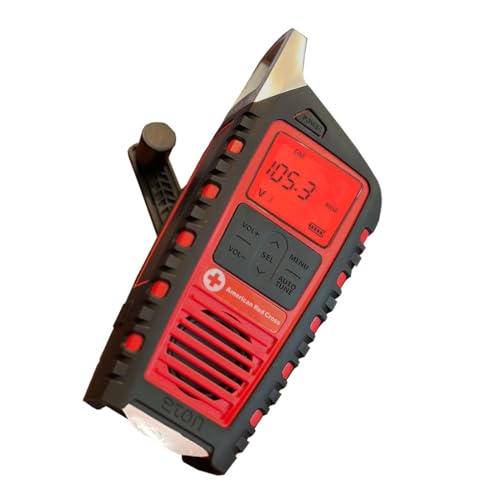
- AM/FM, shortwave, and NOAA weather reception
- Solar, hand-crank, and rechargeable power options
- Flashlight, SOS alarm, Bluetooth, and USB charging
Best For: Preparedness kits and outdoor use requiring broad features
Longest Battery Capacity
UMUTOO 5000mAh Emergency Radio

- 5,000mAh battery for extended backup power
- AM/FM and seven NOAA weather stations
- Flashlight, reading lamp, SOS alarm, and headphone jack
Best For: Power outages and trips where phone charging capacity matters
Compact Essentials

- Hand-crank, solar, and USB-C charging
- NOAA alerts and AM/FM broadcasts
- LED light, SOS beacon, and phone-charging support
Best For: Basic home emergency kits and lightweight outdoor carry
Best All-Around Pick – FosPower A1 Emergency Weather Radio
For shoppers comparing emergency radios with crank, the FosPower A1 stands out as a versatile option with a 2,000mAh power bank, solar and hand-crank charging, and NOAA weather access. It also combines two useful lighting options in a compact, water-resistant design.
Best For: Home emergency kits, outages, and users who want phone charging plus multiple power options.
Pros:
- 2,000mAh power bank can provide emergency power to a phone or small tablet.
- Supports solar, hand-crank, AAA battery, and USB-C charging.
- Includes NOAA, AM, and FM reception, a 1W flashlight, and a four-LED reading light.
- Backed by a limited lifetime warranty.
Cons:
- Requires four AAA batteries when rechargeable power sources are unavailable.
- The power bank is intended for small devices rather than high-demand electronics.
This is a well-rounded choice if you want one emergency device to cover communication, lighting, basic device charging, and weather updates.
Best Simple Hand-Crank Station – Ready America 70801 Emergency Power Station
The Ready America 70801 is a straightforward choice among emergency radios with crank, combining an AM radio, flashlight, siren, and cell phone charger in one hand-powered unit. It requires no batteries, making it useful for basic preparedness storage.
Best For: Buyers seeking a simple, battery-free emergency radio for short-term outages.
Pros:
- Combines radio, flashlight, siren, and cell phone charging.
- Hand-crank operation works without batteries.
- One minute of cranking is rated for up to 30 minutes of light or 15 minutes of radio.
- Includes three phone connectors, including USB and Mini-USB options.
Cons:
- Supports AM only rather than AM/FM or NOAA weather bands.
- Not water resistant.
- The included phone plugs are specified for iPhone 4s and earlier, USB, and Mini-USB devices.
Choose this model for uncomplicated, hand-powered essentials; shoppers wanting weather-band alerts or solar charging should consider a more feature-rich radio.
Best Compact Splash-Resistant Pick – Ywalxskk Wind-Up NOAA Radio
This compact Ywalxskk model offers the core features many shoppers want in emergency radios with crank: AM/FM/NOAA reception, a 2,000mAh rechargeable battery, solar and Type-C charging, and a built-in SOS light and alarm.
Best For: Car kits, camping bags, and compact emergency kits exposed to light splashes.
Pros:
- Can recharge through hand crank, solar power, or Type-C cable.
- Receives AM, FM, and NOAA weather-band broadcasts.
- Includes a three-LED torch and SOS alarm.
- IPX3 splash resistance helps with light spray and splashes.
Cons:
- IPX3 protection does not cover submersion.
- The compact unit uses a mono speaker.
- Solar charging depends on sunlight and is described as slow.
Its small size and multiple charging methods make it practical for portable kits, while its splash rating calls for more protection in heavy rain or wet conditions.
Best High-Capacity Rugged Pick – Roxicosly CR1030 Weather Radio
For shoppers who prioritize backup power, this Roxicosly radio is one of the more substantial emergency radios with crank. It pairs a stated 12,000mAh battery with a large solar panel, hand-crank generator, NOAA alerts, dual lights, and IPX6 waterproofing.
Best For: Extended outages, severe-weather preparation, and outdoor use where battery capacity and water protection matter.
Pros:
- Stated 12,000mAh battery can charge phones and power the radio and lights.
- Offers five power methods, including solar, hand crank, Type-C, built-in battery, and AAA batteries.
- Includes a 5W adjustable flashlight and 12-LED reading lamp.
- Provides AM/FM/NOAA reception, automatic alerts, an SOS alarm, and IPX6 waterproofing.
Cons:
- At 824 grams, it is heavier than the compact options in this roundup.
- The larger feature set may be more than needed for a minimalist kit.
- Phone-charging performance depends on available stored or generated power.
This is the strongest fit for buyers who want a rugged, high-capacity emergency radio with crank and are willing to carry a heavier unit for added lighting and power reserves.
Most Versatile Power Options – FTVOGUE Solar Hand Crank Emergency Radio
For shoppers comparing emergency radios with crank, this FTVOGUE model stands out for combining hand-crank, solar, Micro USB, and optional AA-battery power. It also adds NOAA weather reception, phone charging, and separate lighting for broader outage and preparedness use.
Best For: Home emergency kits, camping, and users who want multiple backup power options.
Pros:
- Offers solar, hand-crank, Micro USB, and 3-AA-battery power options.
- Receives all seven NOAA weather frequencies along with AM and FM.
- Includes a 1-watt flashlight, 2-watt reading light, SOS alarm, and 5V/2A USB phone output.
Cons:
- Its listed warranty is limited to 90 days.
- The product listing contains inconsistent tuner and connectivity details, so buyers should verify specifications before purchase.
This is a feature-rich choice when lighting and backup charging matter as much as radio reception. Its compact wrist-band design also makes it practical for a car kit, backpack, or household emergency supply.
Best Simple Battery Radio – PRUNUS J161 NOAA Weather Radio
Although it is not a crank-powered model, the PRUNUS J161 is worth considering alongside emergency radios with crank if your priority is a lightweight, straightforward battery radio. It receives seven NOAA weather bands, AM, and FM while using only two AA batteries.
Best For: Buyers who want a simple, compact weather radio for an emergency kit or backpack.
Pros:
- Compact 4.7-by-2.8-by-1.2-inch design weighs 0.24 pound without batteries.
- Covers seven NOAA weather bands plus AM and FM reception.
- Simple three-control operation and a headphone jack support easy everyday use.
Cons:
- Does not include a hand crank, solar charging, flashlight, or phone-charging output.
- NOAA alerts are not automatically notified.
- Requires a supply of two AA batteries during outages.
The J161 favors simplicity over multifunction features. It makes sense for listeners who primarily need portable news and weather updates and are comfortable managing spare batteries separately.
Best for Shortwave Listening – EM06 Solar Hand Crank Radio
This EM06 is a practical alternative among emergency radios with crank, pairing hand-crank, solar, and battery operation with AM/FM/shortwave reception. Its USB-A output, 120-lumen flashlight, and SOS strobe make it suited to communication and visibility during outages.
Best For: Emergency kits that need shortwave reception, basic phone charging, and signaling features.
Pros:
- Supports hand-crank, solar, and battery power.
- Receives AM, FM, and shortwave from 5.6–22MHz.
- Includes a 120-lumen flashlight, 75dB SOS alarm, flashing signal, and 5V/1.5A USB-A phone output.
Cons:
- It does not include a NOAA weather band; the listing recommends using local AM/FM for alerts.
- The USB output provides a boost for critical calls rather than a full phone recharge.
- Uses a listed nonstandard battery.
The EM06 is a strong fit when shortwave access and emergency signaling are more important than dedicated NOAA reception. Its compact ABS housing and multiple power sources keep it useful in a go-bag, car, or storm kit.
Most Versatile – Eton Odyssey Adventure Hand Crank Radio
For shoppers comparing emergency radios with crank, the Eton Odyssey stands out as a compact, feature-rich option with AM, FM, shortwave, and NOAA weather reception. Its solar and hand-crank charging, rechargeable battery, flashlight, SOS alarm, and phone-charging output make it useful for both emergency kits and outdoor trips.
Best For: Buyers who want broad radio-band coverage, Bluetooth, and multiple preparedness features in one portable unit.
Pros:
- Receives AM, FM, shortwave, and NOAA weather alerts with RDS.
- Supports solar, hand-crank, and rechargeable-battery power.
- Includes a multi-setting LED flashlight, SOS alarm, USB phone charging, and Bluetooth.
- Backlit LCD display and built-in clock improve everyday usability.
Cons:
- The 2,000mAh battery is smaller than some high-capacity emergency radios.
- Its feature-rich design may be more than shoppers need for basic weather updates.
The Eton is a strong all-around pick when versatility matters. It combines weather information, off-grid power options, lighting, and device connectivity without sacrificing portability.
Longest Battery Capacity – UMUTOO 5000mAh Emergency Radio
This UMUTOO model is a practical choice among emergency radios with crank if phone charging capacity is a priority. It combines a 5,000mAh rechargeable battery with USB-C, solar, and hand-crank charging, while also providing AM/FM/NOAA reception, lighting, and an SOS alarm.
Best For: Households and travelers seeking a larger battery, dual speakers, and multiple lighting modes.
Pros:
- Large 5,000mAh battery is rated to charge more than two phones.
- Offers USB-C, solar, and hand-crank charging options.
- Includes AM/FM and seven NOAA weather stations, plus an SOS alarm.
- Combines a three-mode flashlight, reading lamp, double speakers, and headphone jack.
Cons:
- It is heavier than some compact radios at 1.16 pounds.
- The supplied notes do not specify shortwave reception or Bluetooth connectivity.
With its high-capacity battery and useful lighting setup, the UMUTOO is especially well suited to power outages and extended trips. It is a compelling option for shoppers who value phone backup over extra audio features.
Compact Essentials – LiebeWH Hand Crank NOAA Radio
The LiebeWH offers the core features many shoppers want in emergency radios with crank without an overly complex setup. It provides NOAA alerts and AM/FM broadcasts, hand-crank, solar, and USB-C charging, plus a phone-charging output, LED light, and SOS beacon.
Best For: Shoppers wanting a compact emergency-kit radio for basic weather information, lighting, and backup charging.
Pros:
- Supports hand-crank, solar, and USB-C charging.
- Provides NOAA weather alerts and AM/FM broadcasts.
- Includes a multi-mode LED light, flashing SOS beacon, and loud alarm.
- Compact design offers splash protection for home or outdoor use.
Cons:
- The 2,000mAh battery provides less capacity than the UMUTOO model.
- The supplied specifications list only the 520–1710 kHz range rather than multiple named bands.
- The listed warranty is 90 days.
The LiebeWH is best viewed as a straightforward preparedness tool. Its compact form and essential power, weather, and lighting functions make it easy to keep in a home emergency kit or take camping.
How We Picked the Best Emergency Radios with Crank
We focused on features that matter when conditions are inconvenient or stressful: NOAA weather-band access, AM/FM reception, hand-crank and solar charging, internal battery capacity, replaceable-battery support, lighting, alarms, and phone-charging capability. We also considered portability, control simplicity, and whether a radio’s feature set suits a home emergency kit, vehicle, camping setup, or hiking pack.
Because specifications and real-world performance can vary by model and environment, treat advertised charging times and battery capacities as estimates. A crank radio is a backup tool, not a substitute for a fully charged power bank or primary emergency communication plan.
Quick Comparison
| What to Compare | Best For | Why It Matters |
|---|---|---|
| NOAA weather alerts | Storm and severe-weather preparation | Provides access to official forecasts and warnings when internet service is unavailable. |
| Battery capacity | Repeated charging and extended outages | A larger battery may support longer light use or more phone-charge reserve. |
| Multiple power sources | Home emergency kits | Solar, crank, USB, and replaceable batteries provide more flexibility. |
| Shortwave or Bluetooth | Travel and adventure use | Extra connectivity can be useful, but it may add cost and complexity. |
Key Buying Factors for Emergency Radios with Crank
Weather-Band Coverage and Reception
Prioritize a clear NOAA weather-band tuner if the radio is primarily for hurricanes, tornadoes, winter storms, or power outages. A telescoping antenna and a stable tuning control can improve reception, especially indoors or in remote areas.
Charging and Battery Options
Hand cranks are valuable when no outlet is available, but they require effort and generally produce limited power. Solar charging is useful for maintaining a device over time, while USB charging is faster when a power source is available. Models accepting standard AA or AAA batteries can be especially practical for long-term storage.
Lighting, Alarms, and Charging Ports
Look for a focused flashlight, reading lamp, or both depending on your needs. An SOS alarm may help attract attention, but it should not replace a phone, beacon, or emergency signaling device. Phone charging is best treated as an emergency reserve because it can drain the radio’s battery quickly.
Size and Durability
A larger unit may offer a bigger battery and easier controls, while a compact model is easier to keep in a car or go-bag. Check the handle, switches, ports, and weather resistance before relying on a radio outdoors.
Who Should Buy Which Emergency Radios with Crank?
For a household emergency kit: Choose a model with NOAA alerts, several charging methods, a strong light, and a substantial battery. These features are more valuable than advanced entertainment functions during a prolonged outage.
For camping, hiking, or travel: Favor a lighter radio with dependable crank charging, a flashlight, simple controls, and enough battery capacity for your expected trip. Shortwave or Bluetooth can be worthwhile if you will actually use them.
For a car or compact go-bag: Select a small unit with AM/FM and NOAA reception, replaceable batteries or USB charging, and a protected design. Keep spare batteries and a charging cable with it.
For long outages: Favor higher-capacity batteries and multiple independent power sources, but remember to test the radio periodically, store it charged when appropriate, and replace aging batteries according to the manufacturer’s guidance.

