When severe weather interrupts power or cellular service, a dependable radio can provide essential alerts, forecasts, and backup communication. The best compact emergency radios balance useful reception with practical power options in a size that is easy to store or carry.
This roundup compares 10 options ranging from basic battery-powered AM/FM models to NOAA-equipped radios with solar charging, hand cranks, rechargeable batteries, shortwave bands, and emergency lighting.
Best 10 Compact Emergency Radios Picks for 2026
Best All-Around Backup

- 2,000mAh phone-charging power bank
- Solar, hand-crank, and AAA power options
- NOAA access, flashlight, reading light, and SOS alarm
Best For: Home kits, outages, and outdoor emergencies
Best Pocket Radio

- AM, FM, and shortwave reception
- 125g pocket-friendly design
- Simple controls and replaceable AA batteries
Best For: Pocket carry and straightforward broadcast listening
Best High-Capacity Option
Roxicosly CR1030 Weather Radio

- 12,000mAh emergency battery
- Five charging methods and NOAA alerts
- IPX6 waterproofing with powerful lights
Best For: Extended outages, storms, and outdoor emergencies
Best Mini Travel Receiver

- AM/FM/shortwave digital tuning
- Clock, alarm, sleep timer, and LCD
- Includes a vegan leather carrying case
Best For: Travel, bedside listening, and everyday portability
Pocket Alert Pick
- NOAA alert mode with flashing backlight and alarm
- AM/FM/NOAA tuning with presets
- Pocket-size design powered by two AA batteries
Best For: Portable weather alerts and compact emergency kits
Flexible Power Pick

- AM/FM and shortwave reception
- 5-watt speaker with large, simple controls
- Rechargeable battery plus USB power
Best For: Home, camping, travel, and broad-band listening
Localized Alert Pick
- Supports up to 23 county codes
- Seven NOAA channels and 80+ alert types
- AC power with three-AA battery backup
Best For: Targeted home weather alerts and outage preparedness
Simple Pocket Pick
Panasonic RF-P50D Portable AM/FM Radio
- Compact AM/FM radio with slide-rule tuning
- LED reception and battery indicators
- Runs on two AA batteries; headphones supported
Best For: Simple blackout kits and everyday portable listening
Clip-On Three-Band Value

- FM, AM, and shortwave reception
- Emergency LED flashlight with back clip
- 3W speaker and headphone support
Best For: Portable three-band listening and basic emergency use
Feature-Rich Alert Pick
Rechargeable NOAA Shortwave Radio

- Four-band reception including NOAA weather alerts
- 1250mAh rechargeable battery and flashlight
- 5W speaker with Bluetooth and TF-card playback
Best For: Camping and emergency kits needing weather alerts and rechargeable power
Best All-Around Backup – FosPower A1 Emergency Radio
The FosPower A1 is a practical choice among compact emergency radios when you want weather updates, basic lighting, and backup phone power in one portable unit. It combines solar, hand-crank, and AAA-battery options with AM/FM/NOAA reception.
Best For: Home emergency kits, power outages, and outdoor use where backup charging and lighting are useful.
Pros:
- 7,400mWh (2,000mAh) power bank can provide emergency power to a phone or small tablet.
- Three power sources include solar, hand crank, and four AAA batteries.
- Includes a 1W flashlight, four-LED reading light, SOS alarm, and NOAA weather access.
- Water-resistant design and limited lifetime warranty.
Cons:
- The power bank is smaller than the 12,000mAh capacity offered by some larger emergency radios.
- It requires four AAA batteries when solar or hand-crank power is unavailable.
At 6.2 inches long and 14.8 ounces, the A1 balances portability with useful emergency features. It is a strong fit for buyers who want one compact device for alerts, light, and occasional device charging.
Best Pocket Radio – XHDATA D220 Portable Receiver
The XHDATA D220 is a straightforward option for shoppers seeking compact emergency radios that prioritize portability and replaceable batteries. Its AM, FM, and shortwave reception makes it useful for keeping up with broadcasts without adding charging or lighting features.
Best For: Pocket carry, travel, seniors, and anyone who wants a simple battery-operated news and music receiver.
Pros:
- Compact 125 × 74 × 30mm body weighs 125g without batteries.
- Receives FM, AM, and shortwave broadcasts with a DSP chip for improved reception.
- Simple tuning knob, band switch, and volume/power control are easy to operate.
- Uses two replaceable AA batteries and includes a 3.5mm headphone jack.
Cons:
- AA batteries are not included.
- It is not water resistant and does not provide a flashlight, SOS alarm, or phone charger.
- Shortwave reception is useful for broadcasts but does not replace dedicated NOAA-alert functionality.
With its small size and uncomplicated controls, the D220 is best viewed as a portable broadcast receiver rather than a full emergency-preparedness station. It is a sensible pick when low weight and easy battery replacement matter most.
Best High-Capacity Option – Roxicosly CR1030 Weather Radio
The Roxicosly CR1030 stands out among compact emergency radios for its large claimed battery, broad charging choices, and rugged emergency features. It combines AM/FM and NOAA reception with automatic alerts, lighting, an SOS alarm, and phone-charging capability.
Best For: Extended blackouts, storm preparation, camping, and outdoor users who want higher-capacity backup power.
Pros:
- Built-in 12,000mAh battery is designed to charge phones and power the radio and lights.
- Offers five power options: built-in battery, USB-C, solar, hand crank, and AAA batteries.
- Includes automatic NOAA alerts, a 5W adjustable flashlight, and a 12-LED reading lamp.
- IPX6 waterproof construction supports outdoor and emergency use.
Cons:
- At 824g and 6.8 inches long, it is heavier and larger than pocket-style radios.
- Its extensive features may be more than needed for basic broadcast listening.
- The built-in battery is described as a nonstandard battery, so replacement options may be less convenient.
This model favors capability over minimal size. If your definition of compact includes a grab-and-go emergency unit rather than a pocket radio, its capacity, waterproofing, alerts, and lighting make it one of the more complete choices here.
Best Mini Travel Receiver – Eton Elite Mini Radio
The Eton Elite Mini is a refined choice among compact emergency radios for listeners who want a very small receiver with digital tuning and everyday conveniences. It supports AM, FM, and shortwave listening and adds a clock, alarm, sleep timer, LCD display, and carrying case.
Best For: Travel, bedside listening, backpacking, and buyers who value a compact radio with a polished interface.
Pros:
- Mini 2.7 × 4.3-inch design includes a vegan leather carrying case.
- Digital tuning, orange LCD display, clock, alarm, and sleep timer add convenience.
- Supports AM, FM, and shortwave reception with internal and telescoping antennas.
- Built-in speaker and headphone listening provide flexible audio options.
Cons:
- It does not include a solar panel, hand crank, emergency lights, SOS alarm, or phone-charging power bank.
- AAA batteries are required, and the supplied notes do not specify that they are included.
- The listed 3-band design is less focused on dedicated NOAA emergency alerts.
The Elite Mini is best for portability and regular listening, not as a self-powered disaster kit. Its compact form, digital controls, and included case make it appealing when convenience and everyday use come before emergency utility.
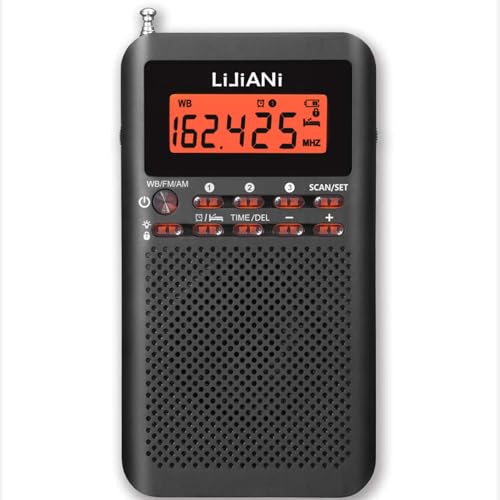
Pocket Alert Pick – Mini NOAA Weather Radio
For shoppers seeking compact emergency radios for a go-bag, bedside table, or travel kit, this pocket-size model combines AM/FM listening with NOAA weather alerts. Its LCD display, backlit controls, memory presets, and two-AA-battery operation keep the design practical for everyday use and power-outage preparedness.
Best For: Portable weather alerts, travel, camping, and small emergency kits.
Pros:
- Automatically responds to NOAA emergency signals with a flashing backlight and alarm when alert mode is activated.
- Supports AM, FM, and NOAA weather bands with automatic or manual tuning.
- Very compact at 4.9 x 2.7 x 0.8 inches and about 0.23 pounds.
- Includes memory presets, an alarm clock, sleep timer, LCD, and backlit buttons.
Cons:
- Requires two AA batteries, which are not included.
- It is not water resistant.
- Its small 1-watt speaker may be less suitable when high volume is needed.
This is a strong choice when portability matters most. It offers useful weather-alert functionality in a genuinely pocketable format, though buyers wanting rechargeable power, water resistance, or a louder speaker may prefer a larger model.
Flexible Power Pick – AM/FM/SW Emergency Radio
This model is a practical option among compact emergency radios for home, travel, or camping. It adds shortwave reception, a large tuning control, a 5-watt speaker, and two charging options, including a built-in rechargeable battery and 5V USB power.
Best For: Buyers who want broad radio-band coverage, simple controls, and rechargeable operation.
Pros:
- Receives AM, FM, and shortwave signals across four selectable bands.
- DSP anti-jamming technology and a telescopic antenna are designed to improve reception.
- Features a clear 5-watt speaker and large controls intended for straightforward operation.
- Can run from its included rechargeable lithium-ion battery or 5V USB power.
Cons:
- It is not water resistant.
- Its listed dimensions are larger than a pocket-size radio.
- The supplied notes do not identify a dedicated NOAA weather-alert function.
Choose this radio if flexible power and shortwave access are more important than the smallest possible footprint. Its larger body may be a trade-off, but the rechargeable battery, USB input, and louder speaker add everyday practicality.
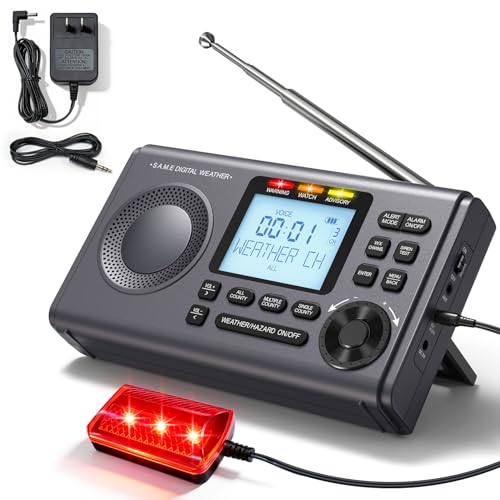
Localized Alert Pick – S.A.M.E. NOAA Weather Radio
For emergency preparedness in storm-prone areas, this RunningSnail unit stands out among compact emergency radios for localized S.A.M.E. alerts and continuous NOAA monitoring. It supports up to 23 county codes, offers configurable notification types, and combines AC power with battery backup for extended outage operation.
Best For: Households needing targeted county alerts, loud warnings, and reliable outage backup.
Pros:
- S.A.M.E. programming supports All, Multiple, or Single County modes and up to 23 county codes.
- Monitors seven NOAA channels and provides more than 80 configurable emergency alert types.
- Offers voice, siren, or visual notifications, including a maximum 110dB siren and external warning light.
- Uses 110V AC power with backup from three AA batteries and is rated for more than 54 hours during outages.
Cons:
- Three AA batteries are required for backup and are not included.
- At 9.4 x 5.7 x 2.6 inches, it is less pocketable than smaller emergency radios.
- Its primary radio coverage is NOAA rather than AM/FM entertainment bands.
This is the most feature-rich alert-focused option of the three. Its county-level targeting, external warning accessories, and dual-power design suit serious home preparedness, while its larger size makes it better for a fixed location than a pocket kit.
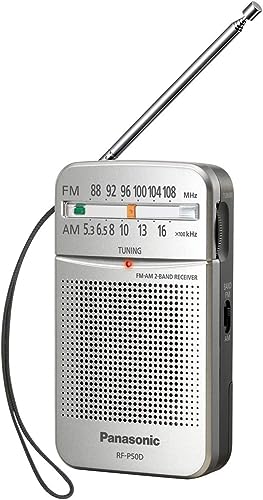
Simple Pocket Pick – Panasonic RF-P50D Portable AM/FM Radio
For shoppers comparing compact emergency radios, the Panasonic RF-P50D is a straightforward AM/FM option with a simple slide-rule tuner, clear audio, and LED reception and battery indicators. It runs on two AA batteries, though they are not included.
Best For: Blackouts, off-the-grid trips, sporting events, and users who prefer uncomplicated analog controls.
Pros:
- Compact 2.75 x 4.62 x 1.16-inch design with a hand strap
- LED tuning indicator helps show when reception is strong
- Battery-level indicator and built-in headphone jack
- 2.25-inch speaker is designed for clear, dynamic sound
Cons:
- Supports AM/FM only, without shortwave or weather-band reception
- Requires two AA batteries, which are not included
- Not water resistant
The RF-P50D is a good fit when reliability means keeping controls and power simple. Its lack of expanded bands and included batteries may matter to shoppers building a more feature-rich emergency kit.
Clip-On Three-Band Value – Handsider R88 Pocket Radio
Among compact emergency radios, the Handsider R88 adds shortwave reception and an emergency LED flashlight while retaining a pocket-friendly design. Its DSP chip, adjustable antenna, back clip, and wrist lanyard make it practical for carrying and positioning.
Best For: Users who want FM, AM, and shortwave coverage in a small radio for indoor and outdoor activities.
Pros:
- Receives FM, AM, and shortwave bands
- DSP chip and adjustable 360-degree antenna are designed to improve reception
- Includes an emergency LED flashlight, back clip, and wrist lanyard
- Upgraded 3W speaker plus headphone support
Cons:
- Two AA batteries are required and not included
- Shortwave reception depends on location and surrounding conditions
- Button markings are placed on the back, which may require a learning curve
The R88 offers more band coverage than a basic AM/FM pocket radio and adds useful carrying features. It is worth considering for flexible listening, but shortwave performance can vary and it does not include rechargeable power.
Feature-Rich Alert Pick – Rechargeable NOAA Shortwave Radio
For shoppers seeking compact emergency radios with more features, this model combines FM, AM, shortwave, and NOAA weather-band reception with a rechargeable battery and flashlight. It also works as a Bluetooth and TF-card audio player, making it useful beyond emergency broadcasts.
Best For: Campers and emergency-kit users who want weather alerts, rechargeable power, loud audio, and extra playback options.
Pros:
- Supports FM, AM, shortwave, and NOAA weather bands
- Built-in 1250mAh rechargeable battery with stated 10-12-hour playback time
- Flashlight, back clip, wrist strap, and bright digital display
- 5W speaker, headphone jack, Bluetooth, and TF-card playback
Cons:
- More controls and features may be less straightforward than a basic analog radio
- Rechargeable operation depends on access to USB-C charging
- The supplied notes do not specify water resistance
This is the most versatile option of the three, particularly for listeners who value NOAA alerts and rechargeable convenience. Its broader feature set may be unnecessary if the goal is simply an inexpensive AM/FM backup.
How We Picked These Compact Emergency Radios
We focused on features that matter during outages, storms, evacuations, and travel: NOAA weather access, AM/FM reception, shortwave capability, multiple power sources, battery capacity, alert functions, speaker clarity, controls, and portability. We also included simpler radios for shoppers who want dependable broadcasts without paying for a large emergency kit.
Because specifications and included accessories can vary by listing, verify the current product details before buying—especially battery capacity, NOAA alert support, charging ports, and whether batteries are included.
Quick Comparison
| Best For | Features to Prioritize |
|---|---|
| Severe-weather readiness | NOAA alerts, S.A.M.E. location support, loud alarm, and backup power |
| Extended outages | Large rechargeable battery, solar panel, and hand-crank charging |
| Travel and hiking | Compact body, light weight, flashlight, and flexible charging |
| Broadcast variety | AM/FM plus shortwave reception and a telescoping antenna |
| Simple everyday listening | Clear tuning, readable controls, reliable batteries, and a strong speaker |
Key Buying Factors for Compact Emergency Radios
Alert Coverage and Tuning
NOAA weather reception is useful for timely forecasts, but not every radio offers automatic alerts. If you need notifications while sleeping or working, look for weather-alert functionality, selectable channels, or S.A.M.E. county programming. Digital tuning can improve station selection, while an analog dial may be faster and simpler in an emergency.
Power Options
Battery operation is convenient, while USB-rechargeable models reduce disposable battery use. Solar charging and hand cranks are valuable backup methods, but they are generally slow and should supplement—not replace—a charged battery or spare cells. A higher-capacity battery can also power a phone, provided the radio specifically supports that function.
Reception, Sound, and Visibility
AM/FM is sufficient for most local broadcasts. Shortwave adds access to more distant stations but depends heavily on antenna position and conditions. Choose a loud, clear speaker for emergency updates, and consider a large dial, illuminated display, or fluorescent pointer if you may use the radio in darkness.
Size and Extras
A flashlight, reading lamp, alarm, clock, belt clip, and Bluetooth connectivity can add useful flexibility. Still, avoid paying for features that increase bulk without improving your emergency plan.
Who Should Buy Which Compact Emergency Radios?
Choose a NOAA-focused model with alert programming if receiving localized weather warnings is your top priority. Select a solar-and-hand-crank radio with a larger battery for power outages and preparedness kits. Pick a compact AM/FM or pocket radio for basic broadcasts, camping, or keeping in a vehicle. If you want broader listening options, choose a shortwave model with a telescoping antenna. Finally, a Bluetooth-equipped radio suits buyers who want emergency capability alongside everyday audio use.

