The best emergency radios with phone charger combine weather alerts, backup power, and practical lighting in one compact tool. They can help you stay informed during storms, power outages, evacuations, and camping trips.
This roundup compares 10 options across battery capacity, charging methods, alert features, radio coverage, and portability so you can choose the right emergency-ready model for your kit.
Best 10 Emergency Radios with Phone Charger Picks for 2026
Best Value Solar Backup
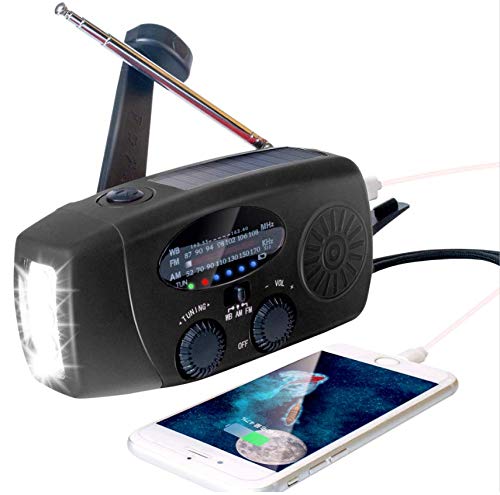
- 2000mAh battery with USB-C, solar, and hand-crank charging
- AM/FM and NOAA weather reception
- 1W flashlight, SOS alarm, and phone-charging capability
Best For: Budget-conscious emergency kits and power outages
Best Long-Run Emergency Radio
Weatherband Radio with Lantern

- Up to 45 hours of use from its rechargeable battery
- AM/FM/weather-band reception with phone-charging support
- Includes flashlight, lantern, siren, and three recharge options
Best For: Extended outages and room-wide emergency lighting
Best Warranty Coverage
FosPower A1 NOAA Emergency Radio

- 7400mWh/2000mAh power bank for phones and small tablets
- Solar, hand-crank, USB, and AAA battery power options
- NOAA reception, dual lights, water resistance, and limited lifetime warranty
Best For: Redundant power and outdoor emergency preparedness
Best High-Capacity Pick
12000mAh Emergency Weather Radio

- Stated 12000mAh battery for phone charging and extended use
- Large solar panel, hand crank, Type-C, and additional power options
- 5W flashlight, 12-LED lamp, NOAA alerts, IPX6 waterproofing, and SOS
Best For: Extended blackouts and rugged storm preparedness
Best Budget Hand-Crank Pick

- USB-A phone charging with 5V/1.5A output
- Hand-crank, solar, and battery power
- 120-lumen flashlight with SOS strobe
Best For: Compact blackout kits needing basic radio and phone backup
Best Localized Weather Alerts
RunningSnail NOAA Weather Radio
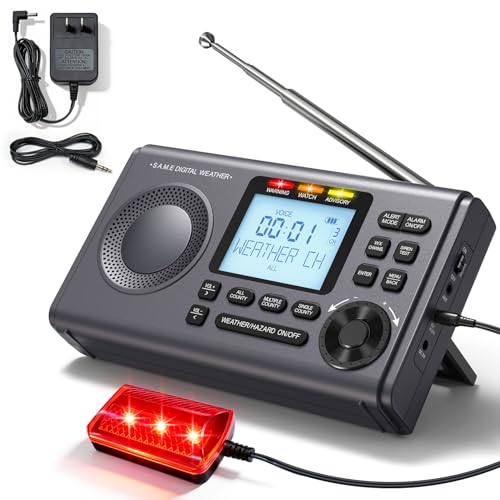
- S.A.M.E. support for up to 23 counties
- 80-plus configurable emergency alerts
- AC and AA backup for over 54 hours
Best For: Home storm preparedness and precise NOAA warning coverage
Best All-Band Outdoor Option
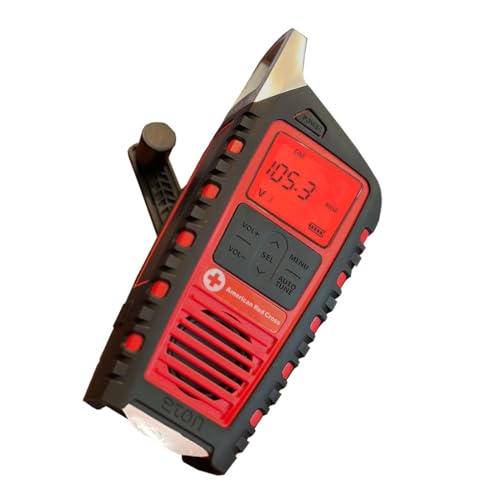
- NOAA, AM/FM, and shortwave reception
- USB phone charger with 2000mAh battery
- Solar, hand-crank, Bluetooth, and IPX4 design
Best For: Camping and emergency kits needing broad functionality
Best Charging Flexibility
FTVOGUE Solar Hand Crank Emergency Weather Radio

- 2500mAh battery with USB phone output
- Four charging methods, including solar and AA batteries
- Compact design with NOAA, lights, and SOS
Best For: Camping, travel, and portable emergency kits
Best Compact Weather Backup
LiebeWH Hand Crank NOAA Weather Radio

- 2000mAh battery for emergency phone charging
- Hand-crank, solar, and USB-C charging
- NOAA alerts, LED light, SOS beacon, and splash protection
Best For: Compact kits, hiking, and camping
Best Value Solar Backup – 2000mAh Crank Weather Radio
For shoppers seeking emergency radios with phone charger capability, this compact Echainstar model combines a 2000mAh battery with USB-C, solar, and hand-crank charging. It also provides AM/FM and NOAA reception, a 1W flashlight, and an SOS alarm for basic home or outdoor preparedness.
Best For: Budget-conscious emergency kits, power outages, and portable weather monitoring.
Pros:
- Offers three charging methods: USB-C, solar, and hand crank.
- Can provide emergency power to a phone or other compatible device.
- Includes AM/FM and NOAA weather reception, a flashlight, and SOS alarm.
Cons:
- The 2000mAh battery is more modest than higher-capacity alternatives.
- Its flashlight output is limited to 1W.
This is a practical, compact choice when you want core emergency features without a larger form factor. Its three recharge options help maintain usability when household electricity is unavailable.
Best Long-Run Emergency Radio – Weatherband Radio with Lantern
WeatherX Weatherband AM/FM Radio with Flashlight, Lantern, and Phone Charger, WR383R
Check Price On AmazonThis WeatherX WR383R is a versatile option for emergency radios with phone charger functionality, adding a flashlight, lantern, siren, and multiple power choices. Its rechargeable battery is rated for up to 45 hours of use, making it useful during extended outages or camping trips.
Best For: Extended power outages, home emergency kits, and users who want broad-area lighting.
Pros:
- Provides AM/FM and weather-band broadcasts for news and emergency information.
- Combines a directional flashlight with an LED lantern.
- Supports outlet, hand-crank, and solar recharging, with up to 45 hours of use.
- Includes an emergency siren and 3.5mm AUX input.
Cons:
- The supplied details identify a rechargeable battery but do not specify its capacity.
- At 1.9 pounds, it is heavier than several compact emergency radios.
- The warranty is limited to 90 days.
Choose this model if lighting coverage and runtime matter as much as radio reception. The lantern and long stated operating time make it particularly suitable for keeping a room functional during a prolonged outage.
Best Warranty Coverage – FosPower A1 NOAA Emergency Radio
The FosPower A1 is a well-equipped choice among emergency radios with phone charger capability. Its 7400mWh power bank can charge a phone or small tablet, while solar and hand-crank generation, AAA battery backup, NOAA reception, and dual lighting support preparedness at home or outdoors.
Best For: Preparedness-minded buyers who want multiple backup power options and durable outdoor features.
Pros:
- Includes a 7400mWh, 2000mAh power bank for small devices.
- Offers solar, hand-crank, USB, and AAA battery power options.
- Provides AM/FM/NOAA reception, a 1W flashlight, and four LED reading lights.
- Has water resistance and a limited lifetime warranty.
Cons:
- The radio requires four AAA batteries, which are not the main rechargeable power source.
- The 1W flashlight may be less powerful than larger outdoor models.
With its power bank, battery fallback, water resistance, and lifetime warranty, the A1 offers a strong balance of redundancy and portability. It is a sensible fit for emergency kits that may also be used for camping.
Best High-Capacity Pick – 12000mAh Emergency Weather Radio
For shoppers prioritizing phone backup power, this Roxicosly emergency radio stands out with a stated 12000mAh battery, a large monocrystalline solar panel, and five charging methods. It adds AM/FM/NOAA reception, automatic weather alerts, IPX6 waterproofing, dual lights, and an SOS alarm for demanding emergency or outdoor use.
Best For: Extended blackouts, storm preparedness, and rugged outdoor activities where extra battery capacity is useful.
Pros:
- Features a stated 12000mAh battery for charging phones and running lights.
- Uses a large 8500mm² solar panel and reinforced hand-crank generator.
- Includes a 5W adjustable flashlight and 12-LED reading lamp.
- Offers AM/FM/NOAA reception, automatic alerts, IPX6 waterproofing, and an SOS alarm.
Cons:
- At 824g, it is less lightweight than compact emergency radios.
- Its larger battery and rugged construction may be more than needed for minimal emergency kits.
This is the most power-focused option in the group, pairing a high-capacity battery with substantial lighting and weather features. It makes the most sense when keeping devices charged through longer outages is a priority.
Best Budget Hand-Crank Pick – EM06 Solar Hand Crank Radio
If you need emergency radios with phone charger capability for a go-bag, car, or blackout kit, the EM06 combines USB-A phone charging with hand-crank, solar, and battery power. It also covers AM/FM and shortwave broadcasts, though it does not include NOAA reception.
Best For: Budget-minded emergency kits that prioritize basic radio coverage, phone charging, and compact portability.
Pros:
- USB-A output provides a 5V/1.5A phone boost for calls or texts.
- Uses hand-crank, solar, and battery power sources.
- Includes a 120-lumen flashlight and SOS alarm with flashing light.
- Compact, lightweight design fits easily in a car or go-bag.
Cons:
- No NOAA weather band; alerts require local AM/FM broadcasts.
- The 2,000mAh phone-charger capacity is intended for a vital boost rather than extensive recharging.
The EM06 is a straightforward, space-saving choice when you want multiple backup power options and basic broadcast access. Its lack of NOAA is the main limitation for buyers seeking dedicated weather alerts.
Best Localized Weather Alerts – RunningSnail NOAA Weather Radio
For shoppers seeking emergency radios with phone charger features, this RunningSnail model takes a different approach: it is built around NOAA monitoring and highly configurable alerts rather than phone charging. S.A.M.E. programming supports up to 23 county codes, while AC and AA battery backup help maintain operation during outages.
Best For: Households in storm-prone areas that want precise NOAA alerts and extended backup operation.
Pros:
- Receives seven NOAA channels and supports 80-plus alert types.
- S.A.M.E. programming can target up to 23 counties.
- Offers voice, siren, or visual alert options with selectable tones.
- Runs from AC power or three AA batteries for more than 54 hours during outages.
Cons:
- It does not list a USB output or phone-charging function.
- Three AA backup batteries are required but not included.
- Its 9.4-inch length makes it less compact than handheld emergency radios.
This is the strongest alert-focused option in the group, especially for users who value county-level NOAA warnings and loud, configurable notifications. Choose another model if charging a phone is a central requirement.
Best All-Band Outdoor Option – Eton Odyssey Adventure Radio
The Eton Odyssey is a versatile choice among emergency radios with phone charger capability, combining USB phone charging with NOAA, AM/FM, and shortwave reception. Solar and hand-crank charging support off-grid use, while Bluetooth, a flashlight, and an SOS alarm make it useful beyond emergency broadcasts.
Best For: Outdoor users and preparedness buyers who want broad radio coverage, phone charging, and camping-friendly features.
Pros:
- Receives NOAA, AM, FM, and shortwave broadcasts with RDS.
- USB output can charge a smartphone or other compatible device.
- 2000mAh rechargeable battery supports solar and hand-crank recharging.
- Includes Bluetooth, a multi-setting flashlight, SOS alarm, and water-resistant IPX4 construction.
Cons:
- At 1.2 pounds and 8.5 inches long, it is less pocketable than smaller radios.
- Its feature-rich design may be more than needed for a basic home emergency kit.
The Odyssey offers the broadest combination of weather coverage, entertainment connectivity, backup power, and outdoor durability in this selection. It is a well-rounded pick when you want one device for emergencies, camping, and off-grid communication.
Best All-Around Backup – NOAA Emergency Weather Radio 2000mWh Solar Hand Crank
For shoppers comparing emergency radios with phone charger capability, this model combines a 2000mAh power bank with solar and hand-crank charging. It also adds NOAA, AM/FM reception, lighting, and a loud SOS alarm for power outages, storms, and outdoor use.
Best For: Home emergency kits and users who want multiple backup power options.
Pros:
- 2000mAh power bank can provide emergency power to a phone or small tablet.
- Solar panel, hand crank, and AAA battery support offer flexible power sources.
- NOAA and AM/FM broadcasts, flashlight, reading light, and SOS alarm add useful emergency functions.
Cons:
- The listed dimensions make it less compact than some portable emergency radios.
- Crank and solar charging depend on available time and conditions.
This is a versatile choice when communication, illumination, and phone backup power matter more than minimizing pack size.
Best Charging Flexibility – FTVOGUE Solar Hand Crank Emergency Weather Radio
This FTVOGUE unit is a practical option among emergency radios with phone charger features, offering a 2500mAh battery, USB phone output, solar charging, a hand crank, and support for three AA batteries. Its NOAA, AM, and FM reception is paired with separate flashlight and reading-light functions.
Best For: Camping, travel, glove-box storage, and households seeking several charging methods.
Pros:
- 2500mAh battery and 5V/2A USB output can charge a phone to an estimated 20–50% in a pinch.
- Four charging methods include solar, hand crank, micro USB, and three AA batteries.
- Compact design with wristband, NOAA coverage, flashlight, reading light, and SOS alarm.
Cons:
- The stated phone-charge range is limited to an emergency boost rather than a full recharge.
- The supplied specifications list a 90-day manufacturer warranty.
Its broad charging choices and compact form make it appealing for portable preparedness, especially when access to outlets may be unreliable.
Best Compact Weather Backup – LiebeWH Hand Crank NOAA Weather Radio
For a compact emergency radio with phone charger functionality, the LiebeWH model provides a 2000mAh battery and supports hand-crank, solar, and USB-C charging. It receives NOAA alerts and AM/FM broadcasts while adding a multi-mode LED light, SOS beacon, and splash-protective enclosure.
Best For: Emergency kits, hiking, camping, and users who need weather alerts in a compact format.
Pros:
- 2000mAh battery supports emergency phone charging.
- Hand-crank, solar, and USB-C charging provide multiple replenishment options.
- NOAA alerts, AM/FM broadcasts, LED light, flashing SOS beacon, and splash protection support outdoor preparedness.
Cons:
- The notes do not specify the phone-charge amount or USB output rating.
- The supplied specifications list a 90-day manufacturer warranty.
This model focuses on essential emergency functions in a relatively compact enclosure, making it a sensible fit for kits where weather alerts and portability are priorities.
How We Picked the Best Emergency Radios with Phone Charger
We focused on the features that matter most when normal power and communication are unavailable: NOAA weather reception, AM/FM coverage, hand-crank and solar charging, internal battery capacity, phone-charging capability, lighting, alarm functions, and portability. Models with shortwave, Bluetooth, S.A.M.E. alerts, or larger batteries may suit specialized needs, while simpler radios can be easier to operate and store.
Because specifications and performance can vary by seller and production run, check the current listing for battery ratings, included cables, charging limits, and alert compatibility before buying.
Quick Comparison
| Best For | Look For | Featured Options |
|---|---|---|
| Basic emergency kits | AM/FM, NOAA, hand crank, flashlight | EM06, NOAA 2000mWh, LiebeWH |
| Longer phone backup | Larger internal battery and solar panel | 12000mAh model, FosPower A1 |
| Localized alerts | S.A.M.E. programming and selectable alerts | RunningSnail WR383R |
| Outdoor versatility | Shortwave, Bluetooth, strong lighting | Eton Odyssey, FTVOGUE |
Key Buying Factors for Emergency Radios with Phone Charger
Charging and Battery Capacity
Hand cranks provide dependable emergency power but are slow and physically demanding. Solar panels are useful for maintaining a charge over time, though they work best in direct sunlight. A larger battery can provide more phone-charging potential, but it usually adds weight and charging time. Treat the USB output as an emergency backup rather than a replacement for a power bank.
Weather Alerts and Radio Coverage
NOAA reception is essential for storm information in supported regions. If you need targeted warnings, choose a model with S.A.M.E. county programming or selectable alert functions. AM/FM is adequate for general broadcasts; shortwave adds access to more stations but can make controls and tuning more complex.
Lighting, Alarms, and Durability
A bright flashlight, reading lamp, SOS alarm, and lantern can be valuable during blackouts. Check whether the lights are independently controlled and whether the radio has a stable, weather-resistant design. Water resistance is useful outdoors, but do not assume a radio is waterproof unless the manufacturer states a specific rating.
Who Should Buy Which Emergency Radios with Phone Charger?
Choose a compact basic model if you want an affordable addition to a home emergency kit or vehicle. Select a high-capacity solar-and-crank model if phone backup is a priority during extended outages. A S.A.M.E.-enabled radio is the better fit for households that need localized warnings, while an all-band or Bluetooth model suits campers and travelers who want broader entertainment and connectivity. For family preparedness, prioritize simple controls, loud alerts, dependable lighting, and a radio that everyone can operate without instructions.

